• Jerusalem

    It’s Tuesday night in the holy city of Jerusalem. It’s our last night in Israel. Tomorrow we fly back to America to be home for Thanksgiving. I’m looking forward to being back home. I’m looking forward to Thanksgiving. And I’m really looking forward to Friday night church at Word of Life. I’ll be preaching on Revelations From Mount Sinai — what the Spirit of the Lord ministered to me when I was on top of Sinai at dawn on November 9.

    But there is also a certain sadness in leaving Jerusalem. I always feel this way when I leave Jerusalem. Jerusalem is the spiritual home of every believer.

    We concluded our tour of Israel today at The Garden Tomb — the site of the crucifixion and the resurrection! It was a very powerful time! We end our pilgrimage tours at the Garden Tomb because it is the place of the most important event in time and eternity. We conduct a worship and communion service at the Garden Tomb and I always take some time to minister the word. Last night as I prepared for the Garden Tomb service, the Holy Spirit gave me this message: Supposing Him To Be The Gardener.

    “Now in the place where Jesus was crucified there was a garden and in the garden a new tomb in which no one had yet been laid. So there they laid the body of Jesus” ~John 19:41

    Joseph of Arimathea and Nicodemus were the two members of the Sanhedrin who did not consent to the death of Jesus. After Jesus’ death on the cross, Joseph obtained permission to take the body of Jesus that he might give Him a decent burial. Joseph had a garden nearby in which was a new tomb. After obtaining permission from Pilate, Nicodemus assisted Joseph in the sad task of taking the body of Jesus from the cross.

    And so Jesus was buried in a garden.

    The Bible tells a story and gardens figure prominently in the Great Story. In fact the Story begins in a garden…and goes wrong in a garden.

    “And the Lord planted a garden eastward in Eden and there He placed the man whom He had formed.” ~Genesis 2:8

    “The man and his wife heard the sound of the Lord God as He was walking in the garden toward evening, in the cool of the day.” ~Genesis 3:8

    God created man for fellowship in a garden paradise.

    But the catastrophe called the Fall caused man to lose Eden.

    “So the Lord God banished Adam and his wife from the Garden of Eden…And after He drove them out He stationed mighty angelic beings to the east of Eden. And a flaming sword flashed back and forth to guard the way to the tree of life.” ~Genesis 3:23-24

    Paradise Lost.

    Thus man began his long exile from the garden. An exile into a wasteland of barren souls and wasted lives — a desert of separation from the fountain of joy and the tree of eternal life.

    But there were prophecies of Paradise Regained.

    “For the Lord will comfort Zion
    He will comfort all her waste places
    He will make her wilderness like Eden
    And her desert like the garden of the Lord
    Joy and gladness will be found there
    Thanksgiving and the sound of melodies.”
    ~Isaiah 51:3

    And in the fullness of time, the prophecies were fulfilled.

    Let us return to the garden where Jesus had been laid in the tomb:

    “But Mary Magdalene stood outside the tomb weeping, and as she wept she stooped down and looked into the tomb. And she saw two angels in white sitting one at the head and the other at the feet where the body of Jesus had been.” ~John 20:11-12

    Do you know what Mary Magdalene is seeing as she sees two angels sitting where the body of Jesus had been?

    She is seeing the new mercy seat. In the Old Covenant the mercy seat was the solid gold lid on the top of the Ark of the Covenant which received the blood of atonement and was covered by the wings of the cherubim at each end. The angels sitting at the head and feet of where the body of Jesus had lain signify that Jesus Himself is the new mercy seat of the new covenant!
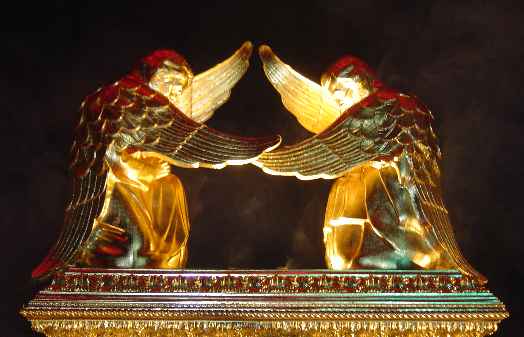
    The angels speak to Mary…

    “Then they said to her, ‘Woman, why are you weeping?’ She said to them, ‘Because they have taken away my Lord and I do not know where they have laid Him.” Now when he had said this, she turned around and saw Jesus standing there, and did not know that it was Jesus. Jesus said to here, ‘Women, why are you weeping? Whom are you seeking?’ She, supposing Him to be the gardener said to Him, ‘Sir, if you have carried Him away, tell me where you have laid Him, and I will take Him away.’ Jesus said to her, ‘Mary!’ She turned and said to Him, ‘Rabboni!'” ~John 20:13-16

    Mary in the early morning shadows and with tears in her eyes made a mistake and mistook Jesus for the gardener.

    Or did she make a mistake after all?

    Let me tell you that Jesus is the Gardener!

    Everywhere Jesus goes, He goes to work as a gardener to restore the Garden of Eden — the garden of everlasting joy, eternal life and fellowship with God. Jesus is the Gardener in the dawn of a new day!

    G.K. Chesterton says it better than I can:

    “On the third day the friends of Christ coming at daybreak to the place found the grave empty and the stone rolled away. In varying ways they realized the new wonder; but even they hardly realized that the world had died in the night. What they were looking at was the first day of a new creation, with a new heaven and a new earth; and in the semblance of a gardener, God walked again in the garden, in the cool not of the evening but the dawn.” ~The Everlasting Man

    Amen! Jesus is the Gardener!

    And I give you this prophetic word. Have faith to receive it as a personal word from the Lord:

    For the Lord Jesus will comfort you
    He will restore your wasted years and your barren life
    He will make your wasteland life like Eden
    And your barren soul like the garden of God
    Joy and gladness will be found in you
    Thanksgiving and the sound of melodies.

    Believe it. Receive it.

    Have a wonderful Thanksgiving.

    I’ll see you Friday.

    I’ll bring a word from Mount Sinai.

    Blessings,

    BZ

  • Galilee Dawn

    I woke up in Galilee this morning.

    I looked out my window and this is what I saw.

    The dawn of a new day.

    Forty of us are on a pilgrimage through the Holy Land. For Peri and me it is our ninth pilgrimage. For many it is their first. For all of us it is a holy time. We awoke to a new day dawning over the Sea of Galilee.

    And Galilee is the place where the new day of the Kingdom of God first began to dawn.

    Consider what the Scriptures say…

    And leaving Nazareth, Jesus came and dwelt in Capernaum by the sea in the regions of Zebulun and Naphtali, that it might be fulfilled which was spoken by Isaiah the prophet saying:

    The land of Zebulun and Naphtali
    By the way of the sea
    Galilee
    Of the Gentiles
    The people who sat in darkness
    Have seen a great light
    Upon those who sat in the shadow of death
    Light has dawned.

    From that time Jesus began to preach and to say: Repent and rethink your life, because THE KINGDOM OF GOD IS AT HAND!

    (Matthew 4:13-17)

    What is the Kingdom of God?

    It is nothing less than the government of God invading the fallen world order and making all things new. The Kingdom of God in its fullness touches and transforms all things: Culture, society, arts, education, economics, government, and not least, the hearts of men. It is the dawn of a new day where the path of the righteous is like the light of dawn growing brighter and brighter until the full day. (Proverbs 4:18)

    My vision for the Kingdom of Heaven — the Kingdom of Christ — prevailing in all the world is burning in my heart as I walk, eat and sleep in the place where the astoundingly good news of this wonderful Kingdom was first proclaimed by the King himself.

    I am being renewed.

    My passion for the King and His Kingdom is burning hotter and brighter.

    Praise the holy name of King Jesus.

    __________________________________________

    Today we were walking and worshiping, teaching and learning in Nazareth, Capernaum, Tabgha (where there is the famous fourth century mosaic commemorating the multiplication of the loaves and fishes) and we ended our day watching the sun set over the Sea of Galilee as fisherman headed out for a night of fishing.

    Tomorrow we will begin our day with a boat ride on the sea of Galilee, followed by a visit to the site of the Sermon on the Mount. Then we will travel north into the Golan Heights to visit Caesarea Philippi (where Jesus introduced the Church); and possibly we will visit the Dan gate where Abraham first entered the Promised Land. We will end the day with a baptism service at the Jordan river.

    I wish you were here.

    Maybe next year.

    Maranatha!

    BZ

    PS

    The final place we visited today was Peter’s Primacy — the place where Jesus restored Peter after his denial (see John 21). Chris Greseth is with us and leading worship, but at Peter’s Primacy I did something I very rarely do…I sang a song for people: Dylan’s Every Grain Sand. It’s a beautiful song that is very appropriate to the place of Peter’s restoration. It’s a song for those of us who are no longer as self-confident as we were in the early days of our walk with Jesus. No longer self-confident, because we have come to know ourselves and how human we are and how prone we are to fail, despite our (over)confident assertions that we will faithfully follow Jesus no matter what. But having learned the painful truth about ourselves, we have also come to know how much we are loved by God and how every aspect of our life is an object of His loving concern.

    A sparrow, a fly, a poisonous insect is an object of God’s concern. It is not a wasted or lost life. What faith it takes to believe that one’s life is noticed by God and that this is enough!

    -Soren Kierkegaard

    Every Grain of Sand
    Bob Dylan

    In the time of my confession, in the hour of my deepest need
    When the pool of tears beneath my feet flood every newborn seed
    There’s a dyin’ voice within me reaching out somewhere,
    Toiling in the danger and in the morals of despair.

    Don’t have the inclination to look back on any mistake,
    Like Cain, I now behold this chain of events that I must break.
    In the fury of the moment I can see the Master’s hand
    In every leaf that trembles, in every grain of sand.

    Oh, the flowers of indulgence and the weeds of yesteryear,
    Like criminals, they have choked the breath of conscience and good cheer.
    The sun beat down upon the steps of time to light the way
    To ease the pain of idleness and the memory of decay.

    I gaze into the doorway of temptation’s angry flame
    And every time I pass that way I always hear my name.
    Then onward in my journey I come to understand
    That every hair is numbered like every grain of sand.

    I have gone from rags to riches in the sorrow of the night
    In the violence of a summer’s dream, in the chill of a wintry light,
    In the bitter dance of loneliness fading into space,
    In the broken mirror of innocence on each forgotten face.

    I hear the ancient footsteps like the motion of the sea
    Sometimes I turn, there’s someone there, other times it’s only me.
    I am hanging in the balance of a perfect finished plan
    Like every sparrow falling, like every grain of sand.

  • Mount Sinai to Mars Hill

    This blog is coming to you from Athens, Greece. Let me bring you up to date.

    On Wednesday Peri and I crossed the border from Israel to Egypt to make our journey to Mount Sinai. We had three Egyptians accompanying us on our journey. A Bedouin driver by the name of Akhmed; a security guard by the name of Mohammad; a guide by the name of Mena, who, much to our surprise, is a passionate believer in Jesus! This gave us a further sense that God was leading us on this spiritual journey. Mena is 24 and was converted a few years ago through some supernatural experiences. Peri is writing an extensive account of our experiences in Sinai and when she completes it, I’ll post it here.

    Here’s a picture Peri took of me and my Sinai Gang.
    Left to Right: Akhmed, BZ, Mohammed (with his German sub-machine gun under his jacket), Mena

    We chose to journey to Mount Sinai, not by the easy way along the paved road from the Red Sea to St. Catherine’s Monastery, but directly across the desert through the Sinai wilderness in a Toyota Land Cruiser. I’m glad we went this way, but it was rough, rough, rough! We were forever from nowhere. Lunch was in a Bedouin tent. I’ll let Peri tell these stories.

    After a couple of hours of sleep we were up at 1:30 AM to begin the hike to the 7,500 summit of Mount Sinai.

    Ready to begin at 2:30 AM
    I’m more excited than I look.

    The hike up Sinai was harder than I expected. (And Moses did it at age 80!)

    At 4:45 we were on top of Sinai. It was 37 degrees. I found a rocky perch next to the ancient monastery to sit, meditate and wait for sunrise. It was November 9 — 32 years to the day after I was saved. What a long strange trip it’s been from Savannah, Missouri to Mount Sinai!

    Sunrise came right at 6:00.

    On top of Sinai.

    The view from Sinai.
    Notice you can see the trail we hiked to reach the top of Sinai.

    I didn’t climb Mt. Sinai as a tourist or on a lark. I had an appointment to meet with God on Sinai. God had given me this word:

    “Come up in the morning to Mount Sinai and present yourself to Me there on top of the mountain.” -Exodus 34:2

    What I prayed and what I felt the Lord say when I was with Him on Mount Sinai, I’ll save to share at a later date (Probably Friday night, November 24).

    I’ll say this much: It was a significant time.

    After we came down from the mountain we had a few hours at St. Catherine’s Monastery — which has a church that has been holding services five times a day for 1,479 years! Then it was another all day drive back through the Sinai, a walk across the border from Egypt back into Israel and an evening flight from Eilat to Tel Aviv. Then we were up a 2:30 AM this morning for our flight to Athens (life can be cruel sometimes!).

    Upon checking into our hotel, I told Peri I wanted to walk to the Areopagus (Mars Hill) where Paul preached to the Athenians in A.D. 53. We asked the clerk at the front desk for direction, but he’d never heard of it. So we struck out on our own…and walked straight to it as though we knew exactly where we were going. I think God helped us do that. Another sign. And the significance of standing on Mount Sinai one day and on Mars Hill the next day did not escape me.

    On Mars Hills.
    Read about what happened here in Acts 17:16-34. Notice the Acropolis in the background.

    As I was flying from Tel Aviv to Athens this morning, I was thinking about the significance of the Sinai and Greece in God’s purposes. This is what I wrote:

    Written language (not hieroglyphic symbols, but letters forming an alphabet) first emerged in the Sinai around 1,500 B.C. This is exactly the time and place where Moses received and wrote the Law of God for the nation of Israel. The first alphabet is Hebrew. It is not inconceivable that the first substantive documents to be written with an alphabet were the books of Moses. But written Hebrew contains only consonants and no vowels. Because of this there is always a bit of mystery and guess work going on. Hebrew unfolds the mystery, but doesn’t explain all the mystery.

    The first language to incorporate vowels in a written language is Greek. Greek made language precise and eliminated the guess work. If Hebrew is the language where mystery begins to unfold, Greek is the language where mystery is revealed.

    Thus the Old Testament was written in the first language to use an alphabet; a written language where the truth of God is contained in a mystery. But the New Testament was written in the first language to be absolutely precise for the reader by utilizing an alphabet containing vowels; a language where mystery can be revealed.

    In my mind there is no doubt that God was at work in the formation of these things. The formation of the Hebrew alphabet for containing the mystery of God and the formation of the Greek alphabet for revealing the mystery of God.

    Then, if you like, you can explore the implications of the Romans perfecting road building at just the time that the New Testament was being completed. This too, I believe, is in the Providence of God, so that the mysteries contained and revealed in the complete Bible — the Hebrew Old Testament and the Greek New Testament — could rapidly spread throughout the known world. The hand of God was in the creation of the Roman roads as well as the Hebrew and Greek languages. God is in the communication business.

    Oh, by the way, you’re reading this on the internet.

    From Athens,

    BZ

    PS

    Peri has completed her account of the first part of our trip into the Sinai.

    Read about it here.

  • At The Red Sea

    Well, this isn’t really going to be a blog…I’m way too jetlagged to say anything very intelligent…I’m just checking in. Peri and I are sitting by the pool at the Hilton Queen of Sheba Hotel on the Red Sea in Eilat, Israel waiting for our room to get ready. We’ve been traveling for 22 hours and we’re a little bit tired, but happy. I didn’t sleep on the plane so I’ve been up for…a long time (I’m too tired to figure it out), and since it’s now 3:00 in the afternoon on Tuesday here, I need to stay up till this evening.

    Traveler’s Tale: After flying all night from New York to Tel Aviv we transferred to the domestic airport to catch our flight to Eilat. At the domestic airport we were informed by Israeli security that our travel itinerary is a bit unusual (New York…Tel Aviv…Eliat…Egypt…Eliat…Tel Aviv…Athens…Tel Aviv) so they needed to give us a bit extra scrutiny. This entailed 45 minutes of questioning. No kidding. One of the problems was I couldn’t convince them that I was a pastor. How about that? They wanted some sort of clergy photo identity card. Hahaha!! As if I would have something like that. And we didn’t have anything with us…no church bulletins or brochures or anything. At one point I pulled out my well-worn, much underlined and annotated bible and tried to convince them that this had to be the bible of a pastor. Finally a phone call to our Israeli tour operator, Gadi Cohen, cleared things up. It was funny. 25 years of full-time pastoral ministry and I couldn’t convince Israeli security that I was a pastor!

    Well, tomorrow morning we leave the hotel at 7:30 to cross the border into Egypt and through the Sinai desert to the Mountain of God (Mount Horeb/Sinai). I have an appointment, you know.

    BZ

    Now Moses was tending the flock of Jethro his father-in-law, the priest of Midian. And he led the flock to the back of the desert, and came to Horeb, the mountain of God. And the Angel of the LORD appeared to him in a flame of fire from the midst of a bush. So he looked, and behold, the bush was burning with fire, but the bush was not consumed. Then Moses said, “I will now turn aside and see this great sight, why the bush does not burn.” So when the LORD saw that he turned aside to look, God called to him from the midst of the bush and said, “Moses, Moses!” And he said, “Here I am.” Then He said, “Do not draw near this place. Take your sandals off your feet, for the place where you stand is holy ground.” Moreover He said, “I am the God of your father — the God of Abraham, the God of Isaac, and the God of Jacob.” And Moses hid his face, for he was afraid to look upon God. -Exodus 3:1-7

  • Beginning the Journey to Mount Sinai…and Beyond

    Peri and I are sitting in the lounge at Newark airport getting ready to board our all night flight to Tel Aviv. We are celebrating 25 years of fulltime ministry with a trip to Israel and Greece and an excursion into the Sinai penisula of Egypt so that we can climb Mount Sinai. Thursday is the 32nd anniversary of my salvation — when as a 15 year old boy I met Jesus in a most dramatic way. At 2:00 A.M. on that day Peri and will begin the three hour climb to the summit of Sinai. Why are we doing this? I have a word from God:

    Be ready in the morning, and come up in the morning to Mount Sinai, and present yourself to Me there on the top of the mountain…Behold, I make a covenant. Before all your people I will do marvels such as have not been done in all the earth, nor in any nation; and all the people among whom you are shall see the work of the LORD. For it is an awesome thing that I will do with you. (Exodus 34:2 & 10)

    I have made Mount Siani on November 9 a point of faith where I will meet with God.

    God says to be there in the morning, so I will. That’s why we’re leaving at 2:00 AM…so we can be on the summit at sunrise.

    I will again dedicate my life to serving God and prepare for the next 25 years.

    This is the promise of God: That he will do a unique thing among us (Word of Life) that will be marvelous and awesome. Amen!

    After we climb down from Sinai, we plan to visit St. Catherine’s Monastery where five worship services a day have been conducted without fail for nearly 1,500 years!

    We will then have a few days in Greece where I am particularly interested in visiting some of the sites connected with the ministry of Paul, before returning to Tel Aviv to meet our group for our 9th tour of Israel.

    I believe that over the next couple weeks I will encounter some significant moments and places in my spiritual pilgrimage.

    I am preparing for 2007 and the next 25 years of ministry!

    On the flight from KCI to NYC I read Following Jesus: Biblical Reflections on Discipleship by N.T. Wright. Some good stuff.

    I’m excited about the next 17 days…and the next 25 years.

    Stay on the journey.

    BZ

  • Heaven Is Coming

    This is too long to be a blog. So, if you like, print it out and pretend it’s something else. A log maybe.

    This is my gleanings from chapter 8 of The Spirit of Early Christian Thought by Robert Louis Wilken. This chapter deals with Augustine’s masterpiece, “The City of God“ — probably the most influential book aside from the Bible in Christian history.

    This blog (log) reflects some of my thinking of late regarding the church, the state, politics and the Blessed Hope.

    _________________________________________

    The City of God can be read as a Christian response to Plato’s Republic. One might have expected Augustine to outline his ideal city, contrasting the city of God with the kind of commonwealth envisioned by Plato. But Augustine does not present a model city, a society human beings should strive to build in this world. His city of God is not an ideal but an actual city, a living community to which one belongs. In a telling phrase in one of his letters, he refers to the city of God as a city one enters, that is, a society of which one becomes a part. Though the life of the city of God is oriented toward the future, it is a social and religious fact. In the very first sentence of the City of God Augustine says that he has taken upon himself the task of “defending the glorious city of God against those who prefer their own gods to the Founder of that city.”

    The City of God, then, is not the defense of an idea or a set of beliefs, but rather a defense of a community that occupies space and exists in time, an ordered, purposeful gathering of human beings with a distinctive way of life. The most characteristic feature of the city of God is that it worships the one true God. Augustine never defines the city of God outright, but it is closely identified with the church. The city of God is more than the church because it includes the angels and the saints who have gone before, but there can be no talk of the city of God without the church.

    His aim in the City of God is to interpret Christianity to the Romans, and with that goal in mind to explain this new community, this other city. Christ’s coming joined people in a more enduring fellowship than the institutions or associations of civil society. Hence Augustine rests his argument not on political theory but on an understanding of the nature of the community whose founder is Christ.

    The Life of the Saints Is Social

    Christian thinking about the city of God begins with the Bible. To introduce the theme of his book Augustine cites three passages, all from the Psalms: “Glorious things are spoken of you, O city of God” (Ps. 87:3); “Great is the Lord and greatly to be praised in the city of our God” (Ps. 48:1); and “There is a river whose streams make glad the city of our God” (Ps. 46:4). All three of these passages are speaking about Jerusalem, the ancient city of Jewish history, and the city where Jesus was crucified and raised from the dead, a place one can locate on a map. But for Augustine the phrase “city of God” in the Psalms also carried another meaning: it designated a company of men and angels who are united in their love of God. His book is about this city; yet to depict this city Augustine speaks of another city, “the city of this world,” the earthly city, the social and political community that exercises dominion over human beings. The two cities must be discussed in tandem because “in this present transitory world, they are interwoven and mingled with one another.” The citizens of the city of God are also citizens of the earthly city, and conversely, many of the citizens of the earthly city belong to the city of God.

    In book 2 he cites Cicero’s De Republica, in which Cicero defines community not as just any association of human beings, but one “united in association by a common sense of law and a community of interest.” The end toward which all human life is directed is peace. “Anyone who joins me,” he says, “in an examination, however slight, of human affairs, and the human nature we all share, recognizes that just as there is no man who does not wish for joy, so there is no man who does not wish for peace.” Even when men go to war their aim is to achieve peace. All our “use of temporal things,” he writes, “is related to the enjoyment of earthly peace in the earthly city.” Peace means order within society: it presupposes law, and it requires justice. Augustine writes, “Peace without justice is not worthy even of the name of peace.”

    This peace for which the city of God yearns is a “perfectly ordered and harmonious fellowship in the enjoyment of God, a peace of enjoying one another in God.” Notice that Augustine’s language is social, and not individualistic. He does not say “fellowship with God,” but enjoying one another in God or “mutual fellowship in God.” Augustine’s controlling metaphor for the new life that God creates is not, for example, being born again, but becoming part of a city and entering into its communal life. Augustine said, “You unite together citizens to citizens so that all are joined together not simply as a social organization but as a family.” Christianity is inescapably social.

    Peace can be realized only in community and enjoyed only when all the members of the community share in that good. As always, Augustine rests his discussion on an apt scriptural text, the one found from the Psalms: “Happy is the people whose God is the Lord” (Ps. 144:15). In a thought-provoking passage late in the work he says that “when the city of God reaches the peace of God there will no longer be enmity, no longer discord, and there will be such mutual trust that the thoughts of our mind will lie open to mutual observation.”

    Things Pertaining to This Life

    Everything that Augustine says about the heavenly city and about the earthly city is related to peace. But peace, as Augustine understands it, can never be fully realized in this life, for the peace that human beings are able to build among themselves is always fragile, unstable, ephemeral. Accordingly, the Scriptures offer no promises concerning peace on this earth. In the Bible, peace is always a matter of hope, and the peace for which the city of God yearns can only be the work of God, not of human hands.

    Christians belong to a community of hope whose end lay outside of history. As Saint Paul wrote, “It is in hope that we are saved,” and Augustine commented, “It is in hope that we are made happy.” And as he was fond of putting it, “the church is the city of God on pilgrimage and it lives on the basis of faith.”

    A Just Society Serves God

    Like other early Christian apologists, Augustine realized that it was not enough to make abstract appeals to transcendent reality, to the god of the philosophers, to a deity that takes no particular form in human life. For Augustine, defense of the worship of the true God could only take the form of a defense of the church, the city of God as it exists on pilgrimage.

    The church is a social fact as well as an eschatological sign. It draws its citizens into a shared public life with its distinctive language, rituals, calendar, practices, institutions, architecture, art, music, in short, with its culture.

    The church is not an instrument to achieve other ends than fellowship with God. It serves society by being unapologetically itself. The greatest gift the church can give society is a glimpse, however fleeting, of another city, where angels keep eternal festival before the face of God.

    The City of God is a book about the church and the God of the Bible. It is only in relation to the church and its destiny that Augustine takes up questions concerning the earthly city. At the end of the City of God Augustine writes:

    How great shall be that happiness, which shall be tainted with no evil, which shall lack no good, and which shall afford leisure for the praises of God, who shall be all in all! True peace shall be there, where no one shall suffer either from himself or any other. The reward of virtue shall be God Himself, who gave the virtue, together with the promise of Himself, the best and greatest of all possible promises. For what did He mean when He said, in the words of the prophet, “I shall be their God, and they shall be My people”? Did He not mean, “I shall be the source of their satisfaction; I shall be everything that men can honorably desire; life, health, food, wealth, glory, honor, peace and every blessing”? For that is the correct interpretation of the Apostle’s words, “so that God may be all in all.” God will be the goal of all our longings; and we shall see Him forever; we shall love Him without satiety; we shall praise Him without wearying. This will be the duty, the delight, the activity of all, shared by all who share the life of eternity. There we shall rest and see, see and love, love and praise. This is what shall be in the end without end. For what other end do we propose to ourselves than to attain to the Kingdom of which there is no end? Amen.

    __________________________________________

    Amen! Heaven is Coming!

    That’s what I’ll be preaching on tonight…Heaven Is Coming.

    My friend from England, Steve Parsons, has a song called Heaven Is Coming. The first part of the song goes like this…

    All around the world
    There’s a guilty feeling
    It’s in the way we live
    And everybody knows
    As all creation groans
    Something’s gotta give

    We serve the money man
    We give him all we can
    But he’s got feet of clay
    Well every tide will turn
    And only then we learn
    That temporary things get washed away

    Hold on, Heaven is Coming

    __________________________________________

    Thy Kingdom come
    Thy Will be done
    On Earth
    As it is in Heaven

    _________________________________________________

    The yearning to escape the noise and smog and madness of modern life
    And lose ourselves in a pristine wilderness
    Is the echo of Eden resounding in our soul
    The grand culmination of Christian faith and hope is
    Heaven is Coming!

    And our happiness lies in that hope.

    Be happy.

    Heaven is Coming!

    BZ

  • Never Ending Tour

    The Colonel and I caught up with Bob Dylan and the Never Ending Tour Wednesday night at the Pershing Auditorium in Lincoln, Nebraska. What a great artist. A modern day Tennyson, Milton or Shakespeare. Just ask Boston University Humanities professor Christopher Ricks.

    Here’s the set list with a few lines from each song…

    Absolutely Sweet Marie
    To live outside the law you must be honest

    Senor (Tales of Yankee Power)

    Senor, Senor, do you know where we’re headin’
    Lincoln County Road or Armageddon?

    Stuck Inside of Mobile with the Memphis Blues Again
    Now the preacher looked so baffled when I asked him why he dressed
    With twenty pounds of headlines stapled to his chest

    Ballad of a Thin Man
    Something is happening here
    But you don’t know what it is
    Do you, Mister Jones?

    Rollin’ and Tumblin’
    Let’s forgive each other darlin’, let’s go down to the greenwood glen
    Let’s put our heads together now, let’s put all old matters to an end

    Workingman’s Blues # 2
    Now they worry and they hurry and they fuss and they fret
    They waste your nights and days
    Them I will forget
    But you I’ll remember always

    Highway 61 Revisited
    God said to Abraham, “Kill me a son”
    Abe says, “Man, you must be puttin’ me on”

    A Hard Rain’s A-Gonna Fall
    And I’ll tell it and think it and speak it and breathe it,
    And reflect it from the mountain so all souls can see it

    ‘Till I Fell In Love With You
    Now I feel like I’m coming to the end of my way
    But I know God is my shield and he won’t lead me astray

    Desolation Row
    She wears an iron vest
    Her profession’s her religion
    Her sin is her lifelessness

    Tweedle Dee & Dweedle Dum
    Living in the Land of Nod
    Trustin’ their fate to the Hands of God

    Spirit On The Water
    I’m traveling by land
    Traveling through the dawn of day
    You’re always on my mind
    I can’t stay away

    Summer Days
    Everybody get ready to lift up your glasses and sing
    Well, I’m standin’ on the table, I’m proposing a toast to the King

    Thunder On The Mountain
    Thunder on the mountain rolling to the ground
    Gonna get up in the morning walk the hard road down
    Some sweet day I’ll stand beside my King
    I wouldn’t betray your love or any other thing

    Like A Rolling Stone
    When you got nothing, you got nothing to lose
    You’re invisible now, you got no secrets to conceal
    How does it feel?

    All Along The Watchtower
    All along the watchtower, princes kept the view
    While all the women came and went, barefoot servants, too
    Outside in the distance a wildcat did growl,
    Two riders were approaching, the wind began to howl

    _________________________________________

    Little known fact: Dylan wrote All Along The Watchtower after reading the prophecies of Isaiah.

    Set a watchman in the watchtower
    Let him declare what he sees
    Then he cried, A lion, my Lord!
    And look, here come a pair of horsemen
    Babylon is fallen, is fallen!

    ~Isaiah 21

    _________________________________________

    It’s Heaven and Hell at Word of Life this weekend.

    Friday Night: Heaven Is Coming

    Sunday Morning: Tour of Hell

    All glory and power to King Jesus!

    BZ

    PS

    Bonus material (of little interest to most people)…

    My current baker’s dozen, one hour zTunes playlist:

    1. Heaven Is Coming ~ Steve Parsons (friend from England)

    2. Red Morning Light ~ Kings of Leon

    3. He Is Coming ~ Lamb

    4. Comfort Ye My People ~ Lamb

    5. Jonah’s Song ~ Druzkhi (Russian friends)

    6. The Man Comes Around ~ Johnny Cash

    7. Sound of Melodies ~ Leeland (coming to WOLC 3/21/07)

    8. Tears of the Saints ~ Leeland

    9. Angelina ~ Bob Dylan

    10. Ring Them Bells ~ Bob Dylan

    11. Senor (Tales of Yankee Power) ~ Bob Dylan

    12. Nettie Moore ~ Bob Dylan

    13. Ain’t Talkin’ ~ Bob Dylan

  • Woodstock

    I just heard the song Woodstock. It made me think.

    Do your remember Woodstock — the music festival on Max Yasgur’s farm in New York, August 15-18, 1969? I was only ten years old, but I remember it. Even at that young age I knew it was something important. The four day festival, which drew over half a million people, was the defining moment of the Sixties counter culture era.

    A little while ago I heard the Crosby, Stills, Nash & Young version of Woodstock. The song was written by Joni Mitchell after she heard about Woodstock from her boyfriend, Graham Nash. Joni says she wrote the song in tears.

    Woodstock
    by Joni Mitchell

    Well I came upon a child of God
    He was walking along the road
    And I asked him where are you going
    And this he told me
    I’m going on down to Yasgur’s farm
    I’m going to join in a rock ‘n’ roll band
    Got to get back to the land
    Going to try and get my soul free

    We are stardust
    We are golden
    We are ten billion year old carbon
    And we’ve got to get ourselves
    Back to the garden

    Then can I walk beside you
    I have come here to lose the smog
    And I feel like I’m a cog in something turning
    Well maybe it is just the time of year
    Or maybe it’s the time of man
    And I don’t know who I am
    But life is for learning

    We are stardust
    We are golden
    We are ten billion year old carbon
    And we’ve got to get ourselves
    Back to the garden

    By the time we got to Woodstock
    We were half a million strong
    And everywhere there was song and celebration
    And I dreamed I saw the bomber jet planes
    Riding shotgun in the sky
    Turning into butterflies
    Above our nation

    We are stardust
    We are golden
    We are caught in the devil’s bargain
    And we’ve got to get ourselves
    Back to the garden

    _________________________________________

    I like that song. It captures a certain kind of yearning. A yearning to get back to the Garden — the Garden of Eden where we can walk with God in the cool of the day.

    But it’s a song without any answers…only yearning.

    We are stardust. All the elements of physical matter are formed in the “factories” of the stars. But we are more than matter, we are also children of God. And oh how we long to find Him and walk with Him again in the garden. But in the end we are caught in the devil’s bargin. That deal that went down with the devil in the garden of our fall.

    Woodstock could not fulfill the hope it evoked. All Woodstock could really offer was sex, drugs and rock ‘n’ roll. And these are nothing more than the standard paltry substitutes for what we are created for: Life in the Garden, life with God.

    Most of you have heard of Joni Mitchell and Crosby, Stills, Nash & Young. Here’s someone you’ve probably never heard of: Bob Ayala. Bob Ayala is a blind singer-songwriter whose work I’ve admired for almost thirty years. He’s not very well known and his older albums are not even available on CD (and that’s a shame). His 1978 album Wood Between The Worlds is one of my favorites (though I haven’t heard it for years…I have it on vinyl, but no turntable). On the title track, Wood Between The Worlds, Bob Ayala points people to the place where the hope of Woodstock can be realized.

    Wood Between The Worlds
    by Bob Ayala

    Swaddled in darkness
    Came forth the Light
    Greater than the world
    He was born in
    And clay was the covering
    Over the Glory
    That was greater than the world
    He was born in

    Jesus
    Jesus

    Brought up by a carpenter
    He took wood and some nails
    And built a bridge between the worlds
    And He stretched out upon it
    And reached up to Heaven
    On the wood between the worlds

    There’s blood on the wood between the worlds
    That can wash away your sin
    There’s blood on the wood between the worlds
    That can make your life begin

    _________________________________________

    The hope of Woodstock: To find our way back to God and the Garden.

    The Wood between the Worlds: The way back to God and the Garden.

    There are people all around you with the “Woodstock yearning” in their heart. They’ve got to get back to the garden.

    Do you know about the wood between the worlds?
    Do you know the way back to the garden?

    Maybe you can help someone find their way home.

    Peace,

    BZ

  • The Difference

    I was asked this question last week:

    God is life. God breathed life into us at the beginning. The human race became the living dead in the garden. The good news is this: God, in the form of Jesus, came back for us. Jesus came back that we might have the life of God in us. No one else is coming back — not Buddha, not Mohamed, not Confucius — no one else.

    Both the atheist and the Christian are human (which is our common ground). I know Christians have to deal with failed marriages, death of a child, sickness, financial hardships, rebellious children, etc. as I assume atheists do.

    What is different about the God life in Christians? It obviously doesn’t keep bad things from happening.

    I’m sure I’m missing something obvious.

    This was my reply (somewhat expanded for this blog):

    The difference is eternal life.

    Consider four levels of existence:

    Rock: Existence without life.

    Tree: Life without awareness.

    Bird: Life with awareness.

    Human: Life with awareness and aware of it.

    The awareness of our awareness is the evidence and perception of the spirit.

    Try this experiment: Take a moment and become aware of your surroundings. Now think about your awareness; become aware of your awareness. This second level of awareness is related to your essence as a spiritual being.

    As I write this I am looking out a window. I see a large rock. It exists. I see a tree. It is alive. I see a bird. It is alive and aware of both the rock and the tree. I see all three and can take another step and see myself within this framework of existence and eventually this evokes the question of WHY? Why do I exist? Why am I aware? Why am I here?

    It is the awareness of our awareness that exposes the vanity of life without a vital relationship with the source of this transcendent awareness (God). Just ask Solomon. Without a relationship with the source of meaning our existence becomes meaningless no matter how aware we are of pleasant surroundings. The only conclusion is that existence is “meaninglessness of meaninglessness, all is meaningless.” (Ecclesiastes 1:2)

    Without a relationship with the Father of Spirits (the source of both transcendent awareness and meaning), our awareness of awareness eventually becomes tormenting.

    This is why awareness of awareness among atheists almost always leads to despair and depression and makes suicide look like the only rational human action. Schopenhauer and Tolstoy understood this. (Tolstoy’s A Confession is a fascinating account of how he came to salvation through a quest for meaning that led him to the brink of suicide and then finally to faith in Christ.)

    So what is the difference between the God-life and the God-less life? Life! Real life, true life, abundant life, eternal life, is not good things happening on the outside (though God does bless us); rather, true life is knowing the only true God and Jesus Christ whom He has sent. (John 17:3)

    Good stuff happening can be the life of a dog. If life is simply having pleasant surroundings and being aware of these pleasant surroundings, but aware of nothing else, well…this can be the life of a dog. And we are made for a higher level of living (as evidenced by the fact that we have the capacity to be aware of our awareness).

    As Blaise Pascal said, “the heart of man is a God-shaped void that nothing of this world can fill.”

    The difference is that the void, the emptiness, the vanity, the meaninglessness is filled by Jesus Christ.

    “And of His fullness we have all received and grace for grace.” (John 1:16)

    Of course we must cultivate the inner life to become aware of this fullness. To reduce the God-life to simply good things happening to us is to reduce life to a “happy animal” level. These are the people who are content to choose the blue pill. Their reward is the ignorant bliss of a dumb beast with a full belly. But those who don’t run away from a transcendent awareness are those who choose the red pill of truth.

    “You’re here because you know something. What you know you can’t explain, but you feel it. You’ve felt it your entire life, that there’s something wrong with the world. You don’t know what it is, but it’s there, like a splinter in your mind, driving you mad. It is this feeling that has brought you to me. Do you know what I’m talking about? It is the world that has been pulled over your eyes to blind you from the truth.” -Morpheus, The Matrix

    “If you abide in My word, you are My disciples indeed. And you shall know the truth and the truth will make you free.” -Jesus (John 8:31-32)

    “I am the way, the truth, and the life. No one comes to the Father except through Me.” -Jesus (John 14:6)

    A rock, a tree, a dog can never be truly free because they are incapable of knowing transcendent truth.

    The person who is aware of transcendent reality but has no vital relationship with the source of this transcendent reality can never be free from his despair (he can only hope to forget it from time to time).

    So humans have three choices:

    1. Never cultivate awareness of awareness and live as a stupid animal. Like a happy cow too dumb to ever find any meaning…but hey, at least the grass is green and tasty.

    2. Cultivate awareness of awareness without finding the meaning of it all…and despair.

    3. Cultivate awareness of awareness and connect with the Father of Spirits through the One who is the way, the truth and the life. This is eternal life. This is the difference.

    The extent of the difference is the difference between Heaven and Hell. Although at first the difference may only be perceived as subtle, in eternity the difference becomes infinite.

    BZ