All posts in Christianity

  • The Christ Illuminated Life

    The following is not a fully developed essay, as I often do when posting a blog, but just some thoughts I will share in our staff chapel tomorrow morning. Feel free to read them if you like.

    “The true light which enlightens everyone was coming into the world.” -John 1:9

    Once a person comes to believe that Jesus is the Christ, there are two options for responding positively to this reality. Allow me to set them forth. Read more

  • The Savior of the World (and DMB)

    “We have seen and testify that the Father has sent his Son to be the Savior of the world” 1 John 4:14

    Do you believe that Jesus is the Savior of the world? This is what the Apostle John claimed in both his gospel and his first epistle. But do you believe it? Do you really believe that Jesus is the savior of the world?

    You know how the famous verse goes…For God so loved the world, etc. And then the next verse: For God did not send his Son into the the world to condemn the world, but that the world through him might be saved.

    Then in the next chapter the Samaritans in Sychar declare that they have come to believe that Jesus is the savior of the world.

    (And I suspect they believed this because they saw how Jesus was capable of mending the breach of historic hostility which separated Jews and Samaritans.)

    But do you believe it? Do you believe that Jesus is the savior of the world? I’m not asking if you believe if Jesus saves individuals who are in the world, but whether you believe Jesus is the savior of the world. Is Jesus the savior of God’s creation and God’s dream of human society living in harmony and exercising dominion as creation’s caretakers? Do you believe that what was lost by the First Adam can be recovered by the Last Adam? Do you believe that the one Mary Magdalene thought was the gardener can restore the Garden? Read more

  • Are Christians afraid of conversation?

    Since the publication of What to Do on the Worst Day of Your Life in March, I have given a few dozen interviews, mainly on talk radio, and I have noticed something that bothers me. These interviews have been pretty evenly divided between mainstream format radio and Christian format radio. Generally, the questions I’m given on mainstream radio are thoughtful, and at times challenging, leading to a lively and substantive conversation. Conversely, the questions I’m typically given on Christian radio are shallow and trite and I have to work at preventing the conversation from becoming glib. That may sound a bit harsh, but I’ll stand by it. Read more

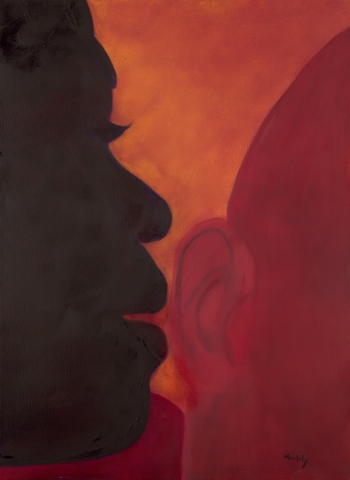
  • A Whisper that Can Change the World

    We live in a loud culture.
    Religious rhetoric.
    Political propaganda.
    Commercial cacophony.
    People can grow deaf to a constant din of shouting.
    They shut it out as annoying background noise.
    That’s when a whisper can be heard above a roar.
    A whisper that is a revelation of a real secret.
    A whisper that belongs to a hidden mystery.
    A whisper that people want to hear.
    A whisper that can change the world.

    No doubt, there is a time and place for a shout.
    But there’s something to be said for a whisper.
    God’s voice in the garden whispering like the wind.
    God’s whisper to Elijah in a voice still and small.
    In a culture grown weary of angry rhetoric,
    I hear the Holy Spirit say…

    Truth can change a man in the wisdom of his days,
    It whispers soft, but constantly,
    You cannot live this way

    I know a secret.
    A beautiful secret.
    But some secrets are too holy and too beautiful for buttons and bumper stickers.
    Some truths are only desecrated when they are turned into slogans.
    But once you believe something beyond being a slogan—
    You believe it more, not less.
    Like this… Read more

  • As I Was Saying. . .

    The problem is I’m trying to say something with words, and that is by no means a precise medium; and it should not be assumed that words are anything more than an approximate representation of reality. What is the spoken word but puffs of air? What is the written word but a series of symbols? A-P-P-L-E is not an apple. And so trying to communicate what you are feeling, sensing, thinking with puffs of air and inscribed symbols. . . well, let’s just say it’s not an exact science. And what if what I’m feeling, sensing, thinking has to do with G O D?

    (Sigh.)

    Trying to use puffs of air and cute little symbols to say something about The One who is transcendent to the universe itself seems almost arrogant.

    But then again God is not only transcendent to the universe (though he is that too), but he has chosen to be a participant in the universe; and not only in the universe but in that curious species that is the human race. For God entered the human race through the most human event of all—conception and birth. And he continued his human journey all the way into death and clear through to the other side—resurrection. Incarnation and Resurrection. Everything that is genuinely Christian is in one way or another a manifestation of or a reflection upon Incarnation and Resurrection. If we understand Incarnation and Resurrection reasonably well, there is a reasonable chance we might get Christianity somewhat right. But if we don’t t do good thinking on Incarnation and Resurrection there is no chance at all of getting Christianity right. Instead, we’ll cook up some religious this or that and call it Christianity, but it will be nothing of the kind. Read more

  • The World and The Dance

    “And in the distance the Jesus-lovers sat with hard condemning faces and watched the sin.”
    –The Grapes of Wrath

    Thus John Steinbeck depicts the world-denying Pentecostals in The Grapes of Wrath as self-righteous , self-appointed morality police who take perverse pleasure in condemning the Saturday night square dance in the California migrant camp. Steinbeck’s terse portrayal of the “Jesus-Lovers” is unflattering, but not an unfair invention of fiction. Unfortunately, such people do exist, and in their existence they horribly distort the good news of Jesus Christ.

    The worst way to define ourselves as Christian is in the negative: What we are against. Steinbeck’s migrant camp Jesus-lovers were against dancing (and most other expressions of humanness). Of course, it is a caricature, but only in that it is perhaps an exaggeration. There remains the misguided tendency to identify ourselves by what we condemn.

    And we have made this quite clear to the wider society. Ask a non-evangelical to define what evangelicals believe and odds are they will not speak in terms of a personal salvation experience (the classical marker of evangelicalism), but will give you a summary of political positions and a list of items evangelicals are opposed to. And that these items may indeed be real evils and not the innocent dance of Steinbeck’s novel is beside the point. The question remains, do we really want to be primarily identified by what we are against? Don’t we have some good news to identify us?

    Here’s the question: What do we think of the world? Are we part of the world or not? Do we love the world or not? Do we have hope for the world or not? Read more

  • Engaging Orthodoxy


    Last month I was riding on a train from Rome to Assisi. Peri and I were going there to explore the stomping grounds of “an Italian poet from the 13th century” — Saint Francis, the remarkable “friar minor” who brought profound spiritual renewal to his generation by creatively preaching a return to the simplicity of the gospel. As I rode on the train I was reading about the development of the Apostles’ Creed on Wikipedia which I had googled on my iPhone, all the while listening to Echoes, Silence, Patience & Grace by the Foo Fighters on my iPod.

    A synchronicity of centuries.

    1st century faith & gospel
    2nd century confession & creed
    13th century poet & prophet
    21st century culture & technology
    On the train from Rome to Assisi

    Engaging Orthodoxy
    Read more

  • Saint Francis of Assisi


    Peri and I are on our way to Israel. Since Tuesday we’ve been in Rome. Yesterday we took a train to Assisi to explore the world of an Italian prophet from the 13th century. Over the past year or so I’ve become fascinated by Saint Francis of Assisi (1182-1226). I’ve read five biographies and listened to one lecture series on Francis. His conversion, his life, his impact upon society are profoundly inspirational. So we went to Assisi.
    Read more

  • Jesus Is For Losers

    Blessed are you who are poor
    For yours is the kingdom of God
    Blessed are you who are hungry now
    For you shall be satisfied
    Blessed are you who weep now
    For you shall laugh
    Read more