All posts in Christianity

  • Ring Them Bells

    bell

    Ring Them Bells
    Brian Zahnd

    We now have a church bell at Word of Life! I’m ridiculously excited about this. I’ve wanted a bell for several years and recently an old church bell was donated to us. We will “debut” our bell this Friday at our Thanksgiving Communion Service and Christmas Tree Lighting.

    But let me tell you about me and the bells.

    I grew up with church bells. My Baptist church had a bell. A group of old men were in charge of ringing it on Sunday mornings. They were quite serious about it. A few times when I was a small child they let me “help” ring the bell. I would hold onto the rope, be pulled off my feet, and the old men would have a good laugh. It’s a fond memory.

    But somewhere along the way church bells began to disappear. They became antiquated. We moved to the suburbs, built our new non-descript utilitarian metal buildings and left the bells behind. Church bells were passé. When we built our church facility in 1996 it never entered my mind to have a bell. And I never thought a thing about not having a church bell.

    Until I began traveling in Muslim countries…
    Read more
  • Deganawida – “The Peacemaker”

    Iroqu1


    Deganawida – “The Peacemaker”

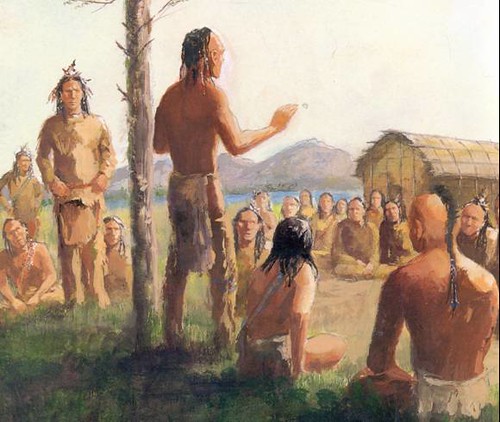
    The Iroquois have a fascinating legend about a savior named Deganawida. The myth seems to have originated during the final decades of Pre-Columbian America. The story goes like this:
    During a time of pervasive fear and instability in the Iroquois world, a young virgin gave birth to a son. The virgin was told in a dream that “your child will be a messenger of the Creator and will bring peace and harmony to the people on earth.” The child was named Deganawida—“The Peacemaker.” When Deganawida had come of age he told his mother, “I shall now build my canoe from white stone, for the time has come for me to start my mission in this world. I know I must travel afar on lakes and rivers to seek out the council smoke of Nations beyond this lake. It is now time for me to go stop the shedding of blood among human beings.” Read more

  • Oh Mercy

    61P2VZXW44L._SL500_SS500_


    OH MERCY
    by Brian Zahnd

    Be perfect as your Father is perfect. —Jesus (Matthew 5:48)

    Be merciful as your Father is merciful. —Jesus (Luke 6:36)

    Let’s keep this short and sweet. To the point.

    The Gospel writers Matthew and Luke give us two different accounts of the Sermon on the Mount.

    In the Sermon on the Mount, Jesus says his disciples are to turn the other cheek, go the second mile, and love their enemies, and they are to do so for this reason: So they can be like their Father who is perfect/merciful.

    The Gospel writers use different words.

    What Jesus in Matthew calls perfection, Jesus in Luke calls mercy. Read more

  • From Word of Faith to the Church Fathers

    EngagingOrthodoxyFrom Word of Faith to the Church Fathers

    Trevin Wax is the managing editor of The Gospel Project and an influential blogger through his regular posts at Kingdom People. He’s a reader, a thinker, a writer, and a lover of Jesus.

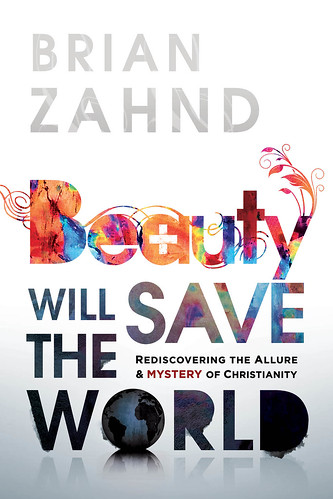
    I first became aware of Trevin Wax when he did a review of my book Beauty Will Save the World. (You can read his review here.)

    Trevin recently interviewed me regarding my theological journey. I thought you might find the conversation interesting so I’m sharing it with you. (The Kingdom People post can be found here.)

    I like the title Trevin gave his post. I’m glad he didn’t entitle it, “Has Brian Zahnd Lost His Mind or What?”

    BZ


    From Word-Faith to the Church Fathers: A Conversation with Brian Zahnd


    A few weeks ago, I reviewed a book by Brian Zahnd – Beauty Will Save the World: Rediscovering the Allure and Mystery of Christianity. Some pastor friends quickly connected me to Brian, and in our subsequent conversations, I discovered how interesting his theological pilgrimage has been. One friend said Brian used to preach like Joel Osteen but now sounds more like Dietrich Bonhoeffer. I invited Brian to the blog to talk about his journey and how it has affected his congregation.


    Trevin Wax: Brian, you’ve had an interesting theological journey in ministry – from Word of Faith type teaching to a celebration of Christianity’s core teachings throughout history. First, tell us about your ministry at the outset – what you were about as a preacher of God’s Word and the vision you had for your local congregation.

    Brian Zahnd: I grew up in a Southern Baptist church in the -60s and -70s but was most influenced by the Jesus Movement. I experienced a rather dramatic conversion when I was 15, and within a couple of years I was leading a coffeehouse ministry; it was primarily a Christian music venue with an emphasis on evangelism. By the time I was 22 the coffeehouse ministry had become a full-fledged church (Word of Life Church in St. Joseph, Missouri).

    From my earliest days as a teenage Christian leader my passion was to call people into a life of following Jesus. That passion has remained consistent over the years. Because the Jesus Movement was closely associated with the charismatic movement our church took on many of the aspects of charismatic Christianity.

    By the late -90s our church had grown to several thousand, and my primary emphasis in preaching could be described as “faith and victory.” Though I think I can honestly say I eschewed the more egregious forms of “prosperity teaching,” I was certainly identified with the Word of Faith movement. The common thread from the Jesus Movement to the Word of Faith movement (whether I was being influenced by Keith Green or Lester Sumrall) was a deep desire to bring people into a vibrant and authentic Christian experience.

    Trevin Wax: What initiated your movement away from Word of Faith teaching to something more in line with historic Christian orthodoxy? 

    Read more

  • Rhythm (Redo)

    Dance-Painting-4

    I’ve been thinking about Advent today. It starts Sunday, you know. (For those of us at Word of Life it really starts Friday night with our Thanksgiving Communion Service and Christmas Tree Lighting.) Anyway, alert reader Gerald Lewis reminded me of this four and half year old post and it seems apropos. So with a few alterations, here is Rhythm (Redo).

    RHYTHM

    Life is full of rhythm.

    The daily rhythm of sunrise and sunset.
    The seasonal rhythm of winter, spring, summer, fall.
    The lunar rhythm seen in the cycles of the moon.

    When we consider the human body we can say life is rhythm.
    The steady rhythm of breathing.
    The syncopated rhythm of the heart.
    The many rhythms of a healthy body.
    When your body is out of rhythm you are sick.
    If the rhythm is not restored you are dead.

    Art is rhythm.
    Dance is rhythm
    Poetry is rhythm.
    Music is rhythm.
    (Pitch is the varying rhythms of frequency.)
    Is symmetry (the essence of beauty) a kind of rhythm?

    Strength is rhythm.
    The engine in your car is a machine for maintaining rhythm.
    When your car is out of rhythm you take it to the mechanic.
    One of the secrets to climbing a mountain is rhythm.
    It’s easier to climb a mountain with rhythm than in fits and starts.

    If String Theory is right…
    (The quantum world consists of single-dimensional oscillating strings.)
    …the entire physical universe is rhythm.

    But we have lost our rhythm. Read more

  • The Moral Theology of the Devil

    lovejoy_and_the_devil_of_delight_0a3331f4b380ab104bb1ebd69c7383ff

    Tonight I watched part two of the Ken Burn’ film “Prohibition” on PBS—a brilliant documentary on America’s fourteen year ill-fated war on alcohol. It’s a classic study in good intentions gone wrong. It’s a penetrating look at the fallacy of thinking, “If we can just pass this or that legislation, we can produce a righteous society.” Anyway, it’s a well-done documentary about a strange time in American history.

    After the documentary I decided to read a random chapter from Thomas Merton’s New Seeds of Contemplation. I chose a chapter entitled “The Moral Theology of the Devil.” It turned out to be entirely apropos for my state of mind. Here are some selections from the chapter.

    The Moral Theology of the Devil
    by Thomas Merton

    The devil has a whole system of theology and philosophy, which will explain, to anyone who will listen, that created things are evil, that men are evil, that God created evil and that He directly wills that men should suffer evil. God has willed and planned it that way.

    As a matter of fact, in creating the world God had clearly in mind that man would inevitably sin and it was almost as if the world was created in order that man might sin, so that God would have an opportunity to manifest His justice.

    So, according to the devil, the first thing created was really hell—as if everything else were, in some sense, for the sake of hell. Therefore the devotional life of those who are “faithful” to this kind of theology consists above all in an obsession with evil. As if there were not already enough evils in the world, they multiply prohibitions [get it!] and make new rules so that man may not escape evil and punishment. Read more

  • That Preacher of Peace

    Pilate-Jesus

    That Preacher of Peace
    by Brian Zahnd

    In his bizarre and surrealistic novel, The Master and Margarita, the critically acclaimed 20th century Russian writer Mikhail Bulgakov creates a fascinating conversation between the Roman governor Pontius Pilate and the Galilean preacher Yeshua. When asked about his views on government, Bulgakov’s Yeshua says, “All power is a form of violence over people.” Yeshua goes on to contrast the governments of power and violence with the peaceable kingdom of truth and justice. In response Pontius Pilate rages, “There never has been, nor yet shall be a greater or more perfect government in this world than the rule of the emperor Tiberius!” When Pilate asks Yeshua if he believes this kingdom of truth will come, Yeshua answers with conviction, “It will.” Of course, Pilate cannot and will not stand for this.

    “It will never come!” Pilate suddenly shouted in a voice so terrible that Yeshua staggered back. Many years ago in the Valley of the Virgins Pilate had shouted in that same voice to his horsemen: “Cut them down! Cut them down!”…And again he raised his parade-ground voice, barking out the words so that they would be heard in the garden: “Criminal! Criminal! Criminal!”…“Do you imagine, you miserable creature, that a Roman Procurator could release a man who has said what you have said to me?…I don’t believe in your ideas!”

    It wasn’t so much the man who upset the Roman governor, but his ideas. Ideas. Ideas are powerful. Ideas are dangerous. Ideas shape our world. Ideas can change our world. Change—what shall we say about that? Slight change is one thing. When slight change is perceived as positive we call it progress. But paradigmatic change, radical change is another thing altogether. We call that revolution. Revolutionary change is precisely what those in positions of privilege and power—people like Pilate—are most threatened by. And this is what makes Jesus and his ideas dangerous. In The Master and Margarita Pontius Pilate seems to have no personal animosity toward the wandering Galilean preacher, but he hates his ideas. In the end what forces the Procurator to condemn Yeshua to crucifixion is the preacher’s revolutionary ideas about power, truth, and violence. If Yeshua had been content to confine himself to the dreamy world of afterlife expectations and not harbored revolutionary ideas about human social structure, Pilate would have seen little reason to bother with Yeshua, much less crucify him. But Yeshua did have revolutionary ideas. And it was Yeshua’s ideas about an alternative arrangement of the world—an arrangement that might best be called “peace”—that resulted in his death by state sponsored execution. Read more

  • Saints and Sages

    anthonythegreat

    ________________________________________

    This morning I read an op-ed piece by a local freelance journalist entitled “Finding Their Religion”. In the column the journalist writes rather disparagingly about “organized religion,” likening it, as Nietzsche did, to “herd mentality.” The writer tells us how she vowed that her children would never be part of the religious herd. Instead, her children will be left to “find their own path” so that they might possess “beliefs they can wholly claim.”

    Yes, authenticity is the order of the day.

    And tradition, so soundly critiqued by modernity, is passé.

    (Of course it remains to be seen if Enlightenment modernity can survive the trial of postmodernity holding up the mirror and revealing [to its horror!] that it too is a tradition—the tradition of critiquing and rejecting all others traditions. The evidence seems to suggest that modernity cannot not survive this withering self-revelation.)

    In her column our interlocutor writes—

    It’s not necessarily a certain God that I want my children to embrace. I can’t say that I believe in the father figure sold by Christian religions. Or the beautiful, gauzy tales of Hellenic gods and goddesses. But I believe in beauty. I believe in awe. I believe that the world is bigger than the tiny chasm of my existence. I want my children to find spirituality in themselves and their surroundings. The wonder of a brightly colored butterfly and a dip in tepid ocean waters should always be reason to celebrate. The Grand Canyon should make them feel small. The suffering of others should bring tears to their eyes…[But] there are so many people, rushing about spouting off their certainties…My voice should be there. It doesn’t matter that my beliefs don’t come prepackaged in ancient text.

    Well, I believe in beauty too. I’ve written a book on the subject of redemptive beauty and I have been a relentless critic of confusing faith with certitude. But one wonders if this critic of organized religion will take the same approach to her children’s mathematical, literary, and scientific education? Read more

  • Beauty Will Save the World

    Beauty Will Save the World 8-3C
    ____________________________________________________________

    Here is the book description for Beauty Will Save the World from my publisher (Charisma House).

    (I’d say they they got the book description just about right. A tip of my hat to whoever wrote it.)
    ____________________________________________________________

    Beauty Will Save the World: Rediscovering the allure and mystery of Christianity
    Publication Date: January 3, 2012

    Brian Zahnd issues a challenge to Christians to discover new vitality through reenvisioning, reimagining and reforming the church according to the pattern of the cruciform.

    For thousands of years artists, sages, philosophers, and theologians have connected the beautiful and the sacred and identified art with our longing for God. Now we live in a day when pragmatism and utilitarian “morals” have largely displaced beauty as a value. The church is no exception—even salvation is commonly viewed in a scientific and mechanistic manner and presented as a plan, system, or formula. We have technology, convenience, security, and a measure of prosperity, but where is the beauty?

    In Beauty Will Save the World, Brian Zahnd presents the argument that this loss of beauty as a principal value has been disastrous for Western culture—and especially for the church. The full message of the beauty of the gospel has been replaced by our desires to satisfy our material needs, to empirically prove our faith, and to establish a Caesar-style kingdom in our world. Exactly those things that Christ was tempted with—and rejected—in the wilderness.

    Zahnd shows that by following the teachings of the Beatitudes, the church can become a viable alternative to current-day political, commercial, and religious power and can actually achieve what these powers promise to provide but fail to deliver. Using stories from the lives of St. Francis of Assisi and from his own life, he teaches us to stay on the journey to discover the kingdom of God in a fuller, richer way.
    ____________________________________________________________

    So what do you think? Would you be interested in reading a book that fits this description?

    BZ