• Leaving Country and Kin

    img_1128040_33684174_23

    Leaving Country and Kin

    Now the Lord said to Abram, “Go from your country and your kindred…”
    And Abram went.
    (Genesis 12:1, 4)

    In the story the Bible tells it’s Abraham who sends the narrative in a new direction—from a steady migration away from God, to a journey into the Unknown and toward God. Prior to Abraham what do we find in the story? Adam and Eve expelled from Paradise, Cain killing Abel and founding human civilization with bloody hands, a violent world under a flood of judgment, and finally Babylon rising in rebellion to God. It’s a world moving away from God.

    Enter Abraham.
    Faith man.
    Walking man.
    Friend of God.
    Patriarch of a new humanity. Read more

  • The Advent of Imagination

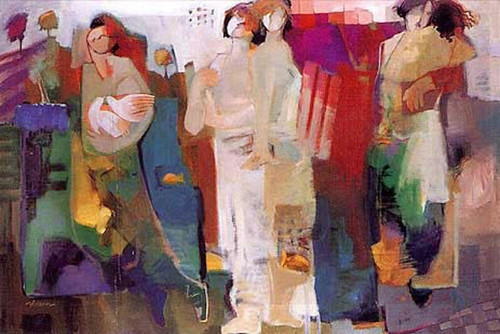
    Abrishami_Hessam_Bounless_Imagination

    ___________________________________________________________

    The Advent of Imagination
    by Brian Zahnd

    Are we lacking in imagination, we children of Cain
    We of the ancient, worn-out myopic Idea
    (Long since unworthy of that noble name)
    The horrid idea born a bastard east of Eden—
    Kill Abel and pretend we don’t know he’s our brother
    Kill Abel and pretend we don’t know better?

    Are we so appallingly lacking in imagination
    That we have no freedom because we have no choices?
    That which has been is what will be
    That which is done is what will be done
    There is nothing new under the sun

    Thus spake the Preacher who lost his imagination
    Thus chanted the Preacher in his mantra of despair.
    (What we need is a greater than Solomon to arrive on the scene!)

    ARE WE SO LACKING IN IMAGINATION?!
    That no sooner do we unlock the secrets of the atom
    (The building blocks of our universe we call home)
    Than we use our (forbidden?) knowledge to build hellish bombs
    Big enough to kill Abel a million at a time…and call it “progress”?

    The zeitgeist is against us
    That spirit of the age
    That vile specter of feigned inevitability
    Brazenly telling us, “Aye, but you have no choice.”

    If we dare to dream an Isaiah-dream
    (Swords morphing to plowshares, spears made pruning hooks)
    If we dare to sing the song of angels
    (Peace on earth, goodwill toward men)
    If we dare to bless those whom Jesus blesses
    (Calling peacemakers the children of God)
    We’re derided and dismissed as “impractical”
    (By the worshipers at the pragmatic altar)
    Called foolish, even dangerous, dreamers
    (By those whose dreams are censored by empire)
    Called bleeding hearts
    (By those whose hearts of stone cannot shed a tear, much less bleed)

    But what’s a bit of ridicule if it comes with the liberation of imagination?
    I for one am ready to be called an impractical, dreamy bleeding heart (or worse)
    If it means we stop justifying the sacrifice of Abel on the altar of pragmatism…
    (Or any other Ism.)

    And so I ask you—
    Test your imagination
    Does the status quo (the existing state of affairs)
    Have to remain an idol pledged allegiance to?
    Has the way we’ve run the world since the (bloodstained) dawn of civilization
    Worked out so very well we must remain wedded to it till death do us part?
    What if the god Status Quo is guilty of spousal abuse?
    Cannot we not sue for divorce
    And marry another?
    Behold, the bridegroom cometh! Go forth to meet him!

    BZ

    (The painting is Boundless Imagination by Hessam Abrishami)

  • Journey of the Magi

    display_image.php

    Journey of the Magi
    by T.S. Eliot

    A cold coming we had of it,
    Just the worst time of the year
    For a journey, and such a long journey:
    The ways deep and the weather sharp,
    The very dead of winter.
    And the camels galled, sore-footed, refractory,
    Lying down in the melting snow.
    There were times when we regretted
    The summer palaces on slopes, the terraces,
    And the silken girls bringing sherbet.
    Then the camel men cursing and grumbling
    And running away, and wanting their liquor and women,
    And the night-fires going out, and the lack of shelters,
    And the cities dirty and the towns unfriendly
    And the villages dirty and charging high prices:
    A hard time we had of it.
    At the end we preferred to travel all night,
    Sleeping in snatches,
    With the voices singing in our ears, saying
    That this was all folly.

    Then at dawn we came down to a temperate valley,
    Wet, below the snow line, smelling of vegetation;
    With a running stream and a water mill beating the darkness,
    And three trees on the low sky,
    And an old white horse galloped away in the meadow.
    Then we came to a tavern with vine-leaves over the lintel,
    Six hands at an open door dicing for pieces of silver,
    And feet kicking the empty wineskins.
    But there was no information, and so we continued
    And arrived at evening, not a moment too soon
    Finding the place; it was (you may say) satisfactory.

    All this was a long time ago, I remember,
    And I would do it again, but set down
    This set down
    This: were we led all that way for
    Birth or Death? There was a Birth, certainly,
    We had evidence and no doubt. I had seen birth and death,
    But had thought they were different; this Birth was
    Hard and bitter agony for us, like Death, our death.
    We returned to our places, these Kingdoms,
    But no longer at ease here, in the old dispensation,
    With an alien people clutching their gods.
    I should be glad of another death.

    _______________________

    An old Magi remembers his hard journey from long ago.
    A hard time we had of it
    He doesn’t regret it. He says—
    I would do it again
    But…
    Finding the King of the Jews came with a price.
    To be a witness of this Birth was to also experience a particular Death.
    (The Magi had thought birth and death were different, but came find out otherwise.)
    Once you get even an inkling of what it really means that Jesus is King—
    Nothing is ever quite the same. Some things will die. For sure.
    We returned to our places, these Kingdoms,
    But no longer at ease here, in the old dispensations,
    With an alien people clutching their gods.

    Ain’t it the truth!
    I know that when I really began to see the Kingdom of God for what it is—
    Cherished assumptions about the nation and life I call mine had to die.
    I was no longer at ease here, in the old dispensation.
    Well, consider this:
    When the Magi made their way home, we’re told they went by “another way.”
    Of course they did.
    Once you see the King, once you have the Epiphany—
    You have to travel through this life by “another way.”
    (Or betray all you have been granted to see.)
    And to an “alien people clutching their gods”—
    You will seem at best odd, and at worse…well, something quite bad.
    Truth doesn’t come cheap.
    The hard journey to a real Epiphany will cost you more than some…
    Gold, frankincense and myrrh.
    It will cost you the way you look at the world.
    Something will have to die. And you may well mourn it.
    To really see the birth of Christ for what it is,
    Will bring you face to face with death—
    Death to what you were once so comfortable with.
    Eliot’s Magi concludes his memoir with this enigmatic line—
    I should be glad of another death.
    What does Eliot mean by that?
    I’m not entirely sure, but I think he means his Magi to say something like this:
    I’m ready even for more,
    More Epiphanies,
    More Births,
    More Stars in the East…
    Which will of course lead to more Deaths.
    That’s the way it works.
    The birth of truth is death to the lie—
    And there are a lot of lies we’ve leaned to love and cherish.
    The price of truth may be the willingness to endure a certain sorrow—
    The sorrow that comes from the death of a loved and cherished lie.
    But now I fear I’ve made the poet say too much.
    Because as another poet warned:

    Tell all the Truth but tell it slant—
    Success in Circuit lies
    Too bright for our infirm Delight
    The Truth’s superb surprise
    As Lightening to the Children eased
    With explanation kind
    The Truth must dazzle gradually
    Or every man be blind—

    BZ

    (The second poem is by Emily Dickinson.)
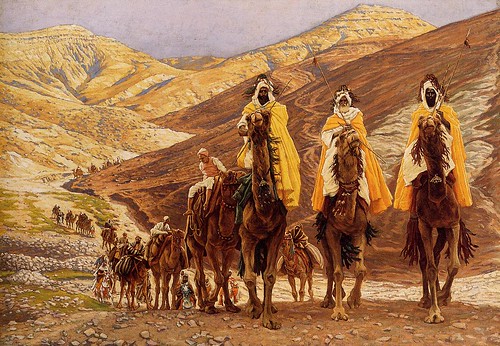
    (The artwork is Journey of the Magi by James Jacques Joseph Tissot)
  • Advent Scripture Reading Guide

    MareDeu Advent and the start of the Christian calendar begins on Sunday, November 27. I love the Christian calendar! It enables us to re-tell, re-live, and re-enter the Jesus Story — from the crowded stable to the empty tomb. We are a peculiar people and we have a peculiar calendar. We live in a secular world but we belong to a sacred story. And so we have two calendars — one secular, one sacred. What we want is to be formed by the Gospel Story. And the Gospel is a story! The Gospel is not a plan or theory or philosophy or ideology — it is a story! The story of Jesus of Nazareth. This is the story told in the Christian calendar: Advent (waiting for Christ), Christmas (the twelve day celebration of Jesus’ birth), Epiphany (the revelation of Christ to the Gentile magi), Lent (the journey to the cross), Holy Week, (Palm Sunday, Good Friday, Holy Saturday), Easter (Resurrection!), Pentecost (the birth of the church). Then it’s Ordinary Time until we return to Advent.

    To help you observe Advent in a richer, more meaningful way, I have put together an Advent Scripture Reading Guide. It comes (mostly) from the second half of Isaiah and the synoptic gospels up to the Transfiguration. It consists of one chapter from Isaiah and one chapter from the Gospels each day (with two chapters from the Gospels on Sundays). So re-enter and re-live the mystery of the Gospel story through this Advent Scripture Reading Guide. (Pass it on to others!)

    Happy Holy Days,

    BZ Read more

  • Rhythm (Redo)

    Dance-Painting-4

    I’ve been thinking about Advent today. It starts Sunday, you know. (For those of us at Word of Life it really starts Friday night with our Thanksgiving Communion Service and Christmas Tree Lighting.) Anyway, alert reader Gerald Lewis reminded me of this four and half year old post and it seems apropos. So with a few alterations, here is Rhythm (Redo).

    RHYTHM

    Life is full of rhythm.

    The daily rhythm of sunrise and sunset.
    The seasonal rhythm of winter, spring, summer, fall.
    The lunar rhythm seen in the cycles of the moon.

    When we consider the human body we can say life is rhythm.
    The steady rhythm of breathing.
    The syncopated rhythm of the heart.
    The many rhythms of a healthy body.
    When your body is out of rhythm you are sick.
    If the rhythm is not restored you are dead.

    Art is rhythm.
    Dance is rhythm
    Poetry is rhythm.
    Music is rhythm.
    (Pitch is the varying rhythms of frequency.)
    Is symmetry (the essence of beauty) a kind of rhythm?

    Strength is rhythm.
    The engine in your car is a machine for maintaining rhythm.
    When your car is out of rhythm you take it to the mechanic.
    One of the secrets to climbing a mountain is rhythm.
    It’s easier to climb a mountain with rhythm than in fits and starts.

    If String Theory is right…
    (The quantum world consists of single-dimensional oscillating strings.)
    …the entire physical universe is rhythm.

    But we have lost our rhythm. Read more

  • A (Troubling) Parable

    6big

    A Parable
    by Lee C. Camp
    From his book Who Is My Enemy?

    A king went out to conquer, amassing great wealth and power. There came to him a people who asserted that some other was king, whom they called “Lord of Lords.” The king replied: you may freely worship this one you call “lord,” you may freely build your buildings and write your books and seek your converts to this one you call “lord.” But I shall rule the marketplace, and the army, and the public square. He shall be your personal “lord,” while I am your public king. I shall make the laws, and you shall obey them. I shall tell you what enemies to kill, and you shall kill them. I shall give you a marketplace, and you shall seek to maximize your profits and keep all your profits, even at the expense of the poor, or the widow, or the stranger, and thence you shall pay taxes with which we shall wage war against all who threaten your freedom to worship your personal “lord.” Read more

  • The Moral Theology of the Devil

    lovejoy_and_the_devil_of_delight_0a3331f4b380ab104bb1ebd69c7383ff

    Tonight I watched part two of the Ken Burn’ film “Prohibition” on PBS—a brilliant documentary on America’s fourteen year ill-fated war on alcohol. It’s a classic study in good intentions gone wrong. It’s a penetrating look at the fallacy of thinking, “If we can just pass this or that legislation, we can produce a righteous society.” Anyway, it’s a well-done documentary about a strange time in American history.

    After the documentary I decided to read a random chapter from Thomas Merton’s New Seeds of Contemplation. I chose a chapter entitled “The Moral Theology of the Devil.” It turned out to be entirely apropos for my state of mind. Here are some selections from the chapter.

    The Moral Theology of the Devil
    by Thomas Merton

    The devil has a whole system of theology and philosophy, which will explain, to anyone who will listen, that created things are evil, that men are evil, that God created evil and that He directly wills that men should suffer evil. God has willed and planned it that way.

    As a matter of fact, in creating the world God had clearly in mind that man would inevitably sin and it was almost as if the world was created in order that man might sin, so that God would have an opportunity to manifest His justice.

    So, according to the devil, the first thing created was really hell—as if everything else were, in some sense, for the sake of hell. Therefore the devotional life of those who are “faithful” to this kind of theology consists above all in an obsession with evil. As if there were not already enough evils in the world, they multiply prohibitions [get it!] and make new rules so that man may not escape evil and punishment. Read more

  • Hints and Guesses

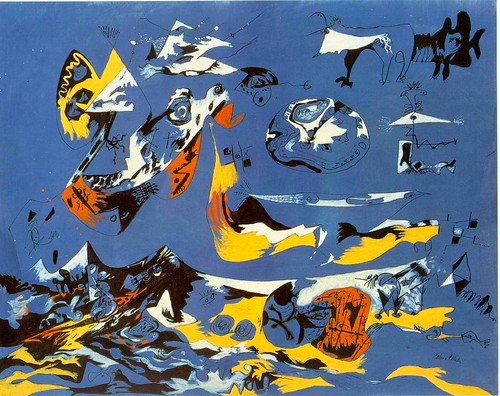
    pollock_moby-dick


    Hints and Guesses

    My favorite thought is the Incarnation.

    My favorite poet (after Dylan) is T.S. Eliot.

    Here is a snippet of T.S. Eliot poetry that touches on Incarnation.

    ____________________________________________

    Men’s curiosity searches past and future
    And clings to that dimension. But to apprehend
    The point of intersection of the timeless
    With time, is an occupation for the saint—
    No occupation either, but something given
    And taken, in a lifetime’s death in love,
    Ardour and selflessness and self-surrender.
    For most of us, there is only the unattended
    Moment, the moment in and out of time,
    The distraction fit, lost in a shaft of sunlight,
    The wild thyme unseen, or the winter lightning
    Or the waterfall, or music heard so deeply
    That it is not heard at all, but you are the music
    While the music lasts. These are only hints and guesses,
    Hints followed by guesses; and the rest
    Is prayer, observance, discipline, thought and action.
    The hint half guessed, the gift half understood, is Incarnation.

    —T.S. Eliot, Four Quartets, The Dry Salvages (from stanza V)

    ____________________________________________

    A little analysis:

    Most of us live in the past and future (memory and imagination); it’s the great saints who have the capacity to live, really live, in the present moment and recognize it for what it is: a slice of infinity. It takes a true contemplative to perceive that mere being brushes against Being (I AM). Heidegger’s Dasein. Moses’ burning bush. But only mystics are fit for that kind of contemplation. Most of us stumble upon this (if at all) through experiences of unanticipated grandeur; a shaft of sunlight, wild thyme, transcendent music. Senses—sight, smell, sound—evoking something deep within. These are but hints and guesses, yet if followed they can lead to the more spiritually formative observances of prayer, thought, discipline, etc. And who knows, maybe it will generate a half-guessed, half-understood encounter with the greatest wonder of all: Incarnation.

    “The Word became flesh and dwelt among us.”

    BZ

    P.S. Analysis turns poetry into prose; it strips it of its magic and makes it, well, prosaic. Analysis reduces a poem to how it spoke in a limited way to the analyst. But it can be helpful for learning how poetry “works.” Oh, and by the way, a lot of the Bible is poetry!

    The artwork is “Blue (Moby Dick)” by Jason Pollock.
    Suggested soundtrack is “Perth” by Bon Iver.

  • That Preacher of Peace

    Pilate-Jesus

    That Preacher of Peace
    by Brian Zahnd

    In his bizarre and surrealistic novel, The Master and Margarita, the critically acclaimed 20th century Russian writer Mikhail Bulgakov creates a fascinating conversation between the Roman governor Pontius Pilate and the Galilean preacher Yeshua. When asked about his views on government, Bulgakov’s Yeshua says, “All power is a form of violence over people.” Yeshua goes on to contrast the governments of power and violence with the peaceable kingdom of truth and justice. In response Pontius Pilate rages, “There never has been, nor yet shall be a greater or more perfect government in this world than the rule of the emperor Tiberius!” When Pilate asks Yeshua if he believes this kingdom of truth will come, Yeshua answers with conviction, “It will.” Of course, Pilate cannot and will not stand for this.

    “It will never come!” Pilate suddenly shouted in a voice so terrible that Yeshua staggered back. Many years ago in the Valley of the Virgins Pilate had shouted in that same voice to his horsemen: “Cut them down! Cut them down!”…And again he raised his parade-ground voice, barking out the words so that they would be heard in the garden: “Criminal! Criminal! Criminal!”…“Do you imagine, you miserable creature, that a Roman Procurator could release a man who has said what you have said to me?…I don’t believe in your ideas!”

    It wasn’t so much the man who upset the Roman governor, but his ideas. Ideas. Ideas are powerful. Ideas are dangerous. Ideas shape our world. Ideas can change our world. Change—what shall we say about that? Slight change is one thing. When slight change is perceived as positive we call it progress. But paradigmatic change, radical change is another thing altogether. We call that revolution. Revolutionary change is precisely what those in positions of privilege and power—people like Pilate—are most threatened by. And this is what makes Jesus and his ideas dangerous. In The Master and Margarita Pontius Pilate seems to have no personal animosity toward the wandering Galilean preacher, but he hates his ideas. In the end what forces the Procurator to condemn Yeshua to crucifixion is the preacher’s revolutionary ideas about power, truth, and violence. If Yeshua had been content to confine himself to the dreamy world of afterlife expectations and not harbored revolutionary ideas about human social structure, Pilate would have seen little reason to bother with Yeshua, much less crucify him. But Yeshua did have revolutionary ideas. And it was Yeshua’s ideas about an alternative arrangement of the world—an arrangement that might best be called “peace”—that resulted in his death by state sponsored execution. Read more