• Saints and Sages

    anthonythegreat

    ________________________________________

    This morning I read an op-ed piece by a local freelance journalist entitled “Finding Their Religion”. In the column the journalist writes rather disparagingly about “organized religion,” likening it, as Nietzsche did, to “herd mentality.” The writer tells us how she vowed that her children would never be part of the religious herd. Instead, her children will be left to “find their own path” so that they might possess “beliefs they can wholly claim.”

    Yes, authenticity is the order of the day.

    And tradition, so soundly critiqued by modernity, is passé.

    (Of course it remains to be seen if Enlightenment modernity can survive the trial of postmodernity holding up the mirror and revealing [to its horror!] that it too is a tradition—the tradition of critiquing and rejecting all others traditions. The evidence seems to suggest that modernity cannot not survive this withering self-revelation.)

    In her column our interlocutor writes—

    It’s not necessarily a certain God that I want my children to embrace. I can’t say that I believe in the father figure sold by Christian religions. Or the beautiful, gauzy tales of Hellenic gods and goddesses. But I believe in beauty. I believe in awe. I believe that the world is bigger than the tiny chasm of my existence. I want my children to find spirituality in themselves and their surroundings. The wonder of a brightly colored butterfly and a dip in tepid ocean waters should always be reason to celebrate. The Grand Canyon should make them feel small. The suffering of others should bring tears to their eyes…[But] there are so many people, rushing about spouting off their certainties…My voice should be there. It doesn’t matter that my beliefs don’t come prepackaged in ancient text.

    Well, I believe in beauty too. I’ve written a book on the subject of redemptive beauty and I have been a relentless critic of confusing faith with certitude. But one wonders if this critic of organized religion will take the same approach to her children’s mathematical, literary, and scientific education? Read more
  • Beauty Will Save the World

    Beauty Will Save the World 8-3C
    ____________________________________________________________

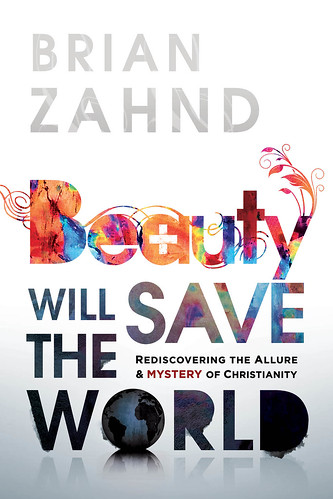
    Here is the book description for Beauty Will Save the World from my publisher (Charisma House).

    (I’d say they they got the book description just about right. A tip of my hat to whoever wrote it.)
    ____________________________________________________________

    Beauty Will Save the World: Rediscovering the allure and mystery of Christianity
    Publication Date: January 3, 2012

    Brian Zahnd issues a challenge to Christians to discover new vitality through reenvisioning, reimagining and reforming the church according to the pattern of the cruciform.

    For thousands of years artists, sages, philosophers, and theologians have connected the beautiful and the sacred and identified art with our longing for God. Now we live in a day when pragmatism and utilitarian “morals” have largely displaced beauty as a value. The church is no exception—even salvation is commonly viewed in a scientific and mechanistic manner and presented as a plan, system, or formula. We have technology, convenience, security, and a measure of prosperity, but where is the beauty?

    In Beauty Will Save the World, Brian Zahnd presents the argument that this loss of beauty as a principal value has been disastrous for Western culture—and especially for the church. The full message of the beauty of the gospel has been replaced by our desires to satisfy our material needs, to empirically prove our faith, and to establish a Caesar-style kingdom in our world. Exactly those things that Christ was tempted with—and rejected—in the wilderness.

    Zahnd shows that by following the teachings of the Beatitudes, the church can become a viable alternative to current-day political, commercial, and religious power and can actually achieve what these powers promise to provide but fail to deliver. Using stories from the lives of St. Francis of Assisi and from his own life, he teaches us to stay on the journey to discover the kingdom of God in a fuller, richer way.
    ____________________________________________________________

    So what do you think? Would you be interested in reading a book that fits this description?

    BZ

  • God Is Like Jesus

    ________________________________________________________

    God is like Jesus.
    God has always been like Jesus.
    There has never been a time when God was not like Jesus.
    We have not always known what God is like—
    But now we do.

    Consider these two foundational truths of Christian theology:

    1. God is immutable. i.e. God does not change and is not subject to change.

    2. God is perfectly revealed in Jesus.
    i.e. Jesus does not change God, Jesus reveals God.

    (see John 1:1, 14-18; 5:19-21; 7:28-29; 8:19; 10:28-30; 12:44-46; 14:7-9)

    Understanding that God is immutable and that God like Jesus is essential to our understanding of salvation. We must not think that salvation comes about because Jesus placates God (thus changing God) or that God is obligated to satisfy retributive justice in order to forgive sin (thus making God subordinate to a higher justice). Salvation comes about because Jesus reveals the Father and does the Father’s work. Jesus tells us that the great work of the Father is to give life to the dead (see John 5 and 11). Thus the primary problem the Gospel addresses is not personal guilt (though this is included), but human subjugation to death. If we think judicial guilt is the primary problem of sin, instead of death (and then falsely imagine that God is responsible for killing Jesus instead of sinful humanity!), we greatly misrepresent the nature of salvation and concoct a distorted gospel where Jesus is saving us from God. No! Jesus reveals the Father, does the work of the Father, and saves us from the dominion of sin and death.

    The Apostle Paul tells us that God was in Christ reconciling the world to himself…not reconciling himself to the world. The cross doesn’t change God (God is immutable). The cross shames the principalities and powers (exposing their claim to wisdom and justice as a naked bid for power) and changes us!

    To hear my full sermon on this topic, the podcast is available here.

    BZ

  • Karl Rahner’s Prayer

    incarnationA
    ____________________________________________

    My friend Sister Ginny, a Benedictine nun, sent me this prayer composed by the great Jesuit theologian Karl Rahner. I think it is worth sharing, worth meditating upon, and most of all, worth praying.

    O God, whenever I think of Your Infinity, I am racked with anxiety, wondering how You are disposed to me. You must adapt Your word to my smallness, so that it can enter into this tiny dwelling of my finiteness—the only dwelling in which I can live—without destroying it. If you should speak such an “abbreviated ” word, which would not say everything but only something simple which I could grasp, then I could breathe freely again. You must make your own some human word, for that is the only kind I can comprehend. Don’t tell me everything that You are; don’t tell me of Your infinity—just say that You love me, just tell me of Your Goodness.

    Beautiful.

    It’s significant that this prayer was composed by a brilliant German theologian.

    You must adapt Your word to my smallness…make your own some human word…

    Of course, this prayer is answered in the Incarnation—the Word made flesh and adapted to our smallness telling us of the love and goodness of God.

    Amen.

    BZ

    (The painting is Incarnation by Edward Longo)

  • The Beautiful Alternative

    angelico

    “Evil is to be overcome by forgiveness. As likewise is violence.”
    -John Milbank, Christ the Exception

    Jesus gives us an alternative to violence. Forgiveness. Jesus didn’t just theorize about it, he lived it. On the cross Christ made his message credible. He lived it all the way to the end. And calls us to follow him.

    I believe most of us long for it to be true. We long for the Jesus way to be the beautiful alternative to the ugly way of violence. Romanticized violence can be appealing—imagined musketeers and Hollywood shoot ’em ups—but real violence is always ugly. In a world awash in endless cycles of violence we know it’s appalling and we wonder if the beautiful way of Christ is a viable alternative. Read more

  • The Idea that Created the Killing Fields

    killing_fields_art_470_470x352

    I will always put the needs of the nation before those of the individual.
    -Nuon Chea

    Nuon Chea (noon chee-ah) was the intellectual who provided the ideology for the Khmer Rouge in Cambodia and was second in command to the infamous Pol Pot. Within the Khmer Rouge, Nuon Chea was known as “brother number two.” From 1975-1979 the Khmer Rouged engaged in a systematic genocide of Cambodian “enemies of the people” that resulted in the death of an estimated two million people…in a nation of only seven million!

    So how does one justify the murder of two million people?

    We don’t have to wonder. Nuon Chea will tell us himself. Read more

  • Manhood Is Not Brutality

    domotorfi

    Rage—Goddess, sing the rage of Peleus’ son Achilles,
    murderous, doomed, that cost the Achaeans countless losses,
    hurling down to the House of the Death so many sturdy souls,
    great fighters’ souls, but made their bodies carrion,
    feasts for the dogs and birds,
    and the will of Zeus was moving toward its end.
    Begin, Muse, when the two first broke and clashed,
    Agamemnon lord of men and brilliant Achilles.
    —The Iliad

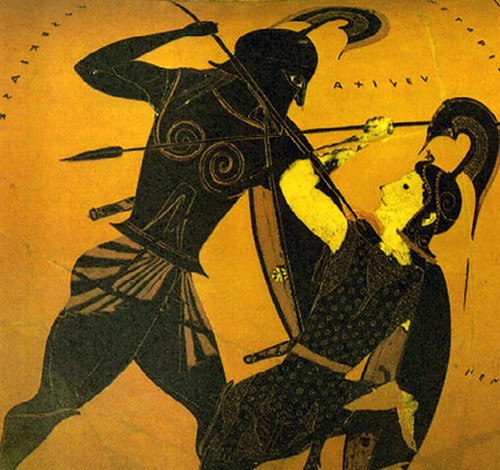
    Western civilization has always had two competing sacred texts: The Iliad and the Bible. We have long pretended we can form a nice synthesis of the two—that Homer’s Achilles and Isaiah’s Immanuel are somehow compatible ideals, but they are not. The rage of Achilles and the peace of Immanuel are fundamentally contradictory visions for the ideal of humanity in general and of manhood in particular. Those who derive their ideal of manhood from the pagan vision personified in Achilles will never be able to reconcile it with the ideal of manhood depicted in Christ. Achilles or Christ? Who is our model of manhood? We must choose. We must choose between the brutal way of Achilles and the peaceable way of Christ. And if you feel compelled to appeal to the whip-wielding Christ in the temple as an attempt to synthesize the two, let me simply say that Christ cleansing the temple is a world away from the violence of The Iliad that dominates imaginations from Homer to Hollywood; i.e. Jesus’ prophetic protest against religious exploitation is no endorsement of a “Walker, Texas Ranger” version of Messiah! Read more

  • Love Economics

    Love-Your-Neighbor

    Love your neighbor as yourself. —Jesus

    Jesus didn’t teach capitalist economics or socialist economics, Jesus taught love economics. In this present fallen age, the competition of a free market is probably the best way to arrange an economy, for the simple reason that the market is far more capable of fixing prices than any central committee. That being said, followers of Jesus must do what they can to make sure that competition is mitigated with copious amounts of compassion; because without compassion we turn the free market into a kind of vicious blood sport where those least equipped to compete are trampled underfoot and left behind. In other words, we must make sure that the losers in the game (and it is a game!) don’t lose everything. The Jesus way requires that love have a place in the economy and that competition be humane and not dog-eat-dog.

    BZ

    (The artwork is Love Your Neighbor by Tema Okun)

  • Blessed are the Meek

    St_FrancisPreachingtotheBirds_Giotto

    “Blessed are the meek, for they will inherit the earth.” —Jesus

    At the top of a list of things Jesus said that we don’t really believe I would place the third beatitude. Here are some of my thoughts on this most unsettling saying from Christ.

    What is Jesus really saying in the third beatitude? Is it something like this?—

    Blessed are the quiet and content, the humble and unassuming, the gentle and trusting who are not grasping and clutching, for God will personally guarantee their share when heaven and earth become one.

    Matthew tells us that the multitude which formed the audience for Jesus’ Sermon on the Mount was a mixed multitude coming from different places and representing diverse ethnic, religious and political backgrounds (see Matthew 4:25). There were religious Jews from Judea with their devout commitment to Torah observance and keeping kosher. There were Galilean Jews for whom synagogue life, though important, was not the obsession it was for the Judeans. There were non-observant Jews who, having dropped out of religious life altogether, were dubbed “sinners.” There were Greeks from the Decapolis region with their sophisticated love of art, philosophy, and athletics. And of course there were the Romans—the triumphant foreign occupiers from the dominant superpower. What Jesus has to say in the Beatitudes and the Sermon on the Mount he addresses to all of these people. His sermon is not instructions on how to be religious or how to be Jewish (or Christian)—Jesus’ instructions are on how to be human. Jesus is revealing to the human race the narrow way that leads to life. Jesus is teaching us the counterintuitive way of God that makes life livable.

    Perhaps the most counterintuitive of all the Beatitudes is the third blessing Jesus bestows. Jesus blesses the meek—the quiet, the gentle, the non-assertive, the non-aggressive—saying they will inherit the earth. But I doubt we believe this. We would say something different. Something like—“Blessed are the meek, for even though they come in last, they’ll be called a nice guy, receive a certificate of participation, and be named ‘Miss Congeniality.’” That’s what we think about the meek—but it’s not what Jesus says! Jesus says the meek will inherit the earth. Inherit the earth?! Really? Read more