All posts in Christianity

  • The Mark of Cain


    Thinking out loud.

    Sitting on my deck thinking. Thinking.

    What am I?

    A human being?

    Yes. But what more can be said?

    A pastor?

    This is what I do, but not really what I am.

    To cease vocation is not to cease being.

    What are you?

    A human too.

    A Christian?

    Perhaps, but that reflects a religious choice.

    Can we come closer to the essence of being?

    Can we be more basic?

    What are you?
    Read more

  • Hope of Glory

    Christ in you the hope of glory.

    Colossians Chaper One, Verse Twenty-Seven.

    Seven words. All but one monosyllabic. Simple. But what does it mean?

    CHRIST…YOU…HOPE…GLORY


    Read more

  • The Jesus Movement


    I keep copies of two historic Time magazines in my study.

    One is the famous 1966 Time asking the question: Is God Dead?

    The other is from 1971 reporting on: The Jesus Revolution

    Following up on my Revival? blog, here are some thoughts on the Jesus Movement.

    Modernity’s 300 year Enlightenment Project ended badly. Not only did it result in the abandonment of Utopian dreams brought on by the Holocaust and Hiroshima, it also inserted Nietzsche’s assertion that God is dead into the postmodern world, at least in the form of a question: Is God dead? In keeping with what Nietzsche was really saying, the question is intuitively understood in the postmodern Western world as — Is Christianity still relevant?

    The Jesus Movement was the answer.

    April 8, 1966: Is God Dead?

    June 21, 1971: The Jesus Revolution

    The Jesus Movement was the first postmodern revival and as such is a kind of prototype for what I’ve taken to calling unrevival.
    Read more

  • Revival?


    I’ve been thinking on my “thinking day.” Thinking about…

    Revival.

    For evangelicals it’s a powerful and evocative word. It can almost cast a spell upon us. It conjures images of great days gone by and elicits the hope that perhaps it could happen again. You know, the second coming of Charles Finney and the ghost of D.L. Moody. If the word revival is spoken in the right way and in the right setting it can cause Christians to get a faraway look in their eyes and a pang in their soul. Especially if we happen to be living in a time when it is generally assumed the world is going to hell in a hand basket.

    (A hand basket? Why a hand basket? Well, that’s what they say.)

    I’ve been fascinated with revival ever since my conversion in 1974. It was during the height of the Jesus Movement and since I already had strong counterculture sympathies I promptly became the school Jesus freak. Overnight I went from Led Zeppelin to Larry Norman, started carrying a bible to school and traded my Erich von Daniken books for the writings of Watchman Nee. Pretty soon I was conducting bible studies almost every night of the week and helping lead a Christian coffeehouse. Then through the personal influence of Keith Green and Leonard Ravenhill I became student of historical revival and a seeker of contemporary revival for my own generation.

    Actually the Jesus Movement was a revival — a new kind of revival. It was not a geographically centered revival but a demographic revival located among the youth counterculture, though few evangelicals were able to recognize it as a revival at the time.
    Read more

  • Anastasis


    This is another blog that is actually a letter. I was in conversation with an important Christian leader and I had asked him this question: “Why did Jesus come?” He answered, “So we can go to heaven when we die.” I told him this was the wrong answer and explained the true purpose of the Incarnation and the true nature of salvation. A short time later he asked me to to put what I had said to him in writing so that he could preach on it. The following is my reply. It is by no means a full treatment of the subject, but the “notes” of what I said during our conversation:

    Why did Jesus come? The answer is not, “so we can go to heaven when we die.”

    The problem with saying that Jesus came so that we can go to heaven when we die is that it diminishes the full scope of salvation and misunderstands the purpose of humanity.

    God created man from the dust of the earth, breathed into him the breath of life and in this act man became the creature that is uniquely human. (Genesis 2:7)

    Animals are physical creatures (dust of the earth) while angels are spirit beings (breath of God), but humans are neither animals nor angels. Humans are a hybrid creature suited for both the heavens (spiritual dimension) and the earth (physical dimension).
    Read more

  • Crassus and The Appian Way

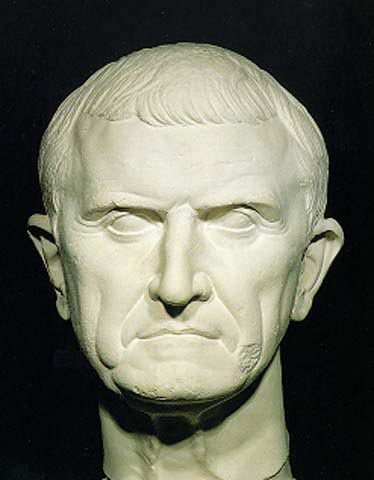
    Marcus Licinius Crassus

    I promise you a new Rome.
    I promise you a new Empire.
    -Marcus Licinius Crassus

    Went down the road to Damascus,
    The road to Mandalay
    Met the ghost of Caesar
    On the Appian Way
    He said, It’s hard to stop this binging
    Once you get a taste
    But the road to empire
    Is a bloody, stupid waste
    And it’s a long road out of Eden
    -The Eagles

    My kingdom is not of this world.
    -Jesus

    An Ides of March and Palm Sunday Blog

    The Appian Way.
    The Great Road to Rome.
    The Road of the Roman Triumphs.
    “All roads lead to Rome.”
    I hope not.
    I believe there is another way.
    A better way than the Appian Way.
    The King’s Highway.
    Read more

  • Being A Christian In America

    “Christians traditionally have been worried about getting Jesus wrong. American Christians are not so worried. There isn’t the sense that this is a life-and-death matter, that you don’t mess with divinity. There’s a freedom and even a playfulness that Americans have…the flexibility of the American Jesus is unprecedented. There’s a Gumbylike quality to Jesus in the United States. Even turning Jesus into a pal among born-again Christians—that kind of chutzpah is unknown historically.” -Stephen Prothero, American Jesus: How the Son of God Became a Cultural Icon

    I recently gave a series of messages where I attempted to answer this question: What does it mean to be a Christian? I talked about the Christian as the convert, the believer and the disciple. Those messages are available as archived audio at the Word of Life site.

    What I said in those messages was a general treatment of the subject dealing with broad truths pertaining to what it means to be a Christian irrespective of time or place. But as we actually attempt to live out a Christian life we don’t do it in a vacuum, but in specific times and cultures, and each age and culture presents its own particular challenges to living the Christian life, whether it’s as a 4th century Roman, a 7th century Byzantine, a 13th century Italian, a 17th century Russian, or a 21st century American. So let me share a few thoughts that are pertinent to what it means to be a Christian in the specific context of contemporary American life.
    Read more

  • What Does It Mean To Be A Christian?

    Beginning Sunday, January 20th, Pastor Brian Zahnd will be teaching a three week series entitled, “What Does It Mean To Be A Christian?” inspired by a question received on his Facebook page.
    Read more

  • When Do We Live?


    The glory of God is a man fully alive.
    -Irenaeus, 2nd century church father

    The medieval theologian Bede the Venerable gave a parable where he likened human existence to that of a bird that in the night flies out of the darkness into a dimly lit room of a castle, lights for a moment, and then flies out the opposite window. Bede meant to present human existence as transitory and essentially preparatory for the next. This was the prevailing medieval view of human existence.

    Then the Renaissance happened.

    With the Renaissance came a new way of looking at life. Human existence came to be viewed as worthwhile. Worthwhile for its own sake.

    For medieval theologians like Thomas Aquinas, all that mattered was the glory of God. Renaissance thinkers like Leonardo da Vinci emphasized the dignity of man. The mistake we don’t want to make is to think that these views are mutually exclusive. They are not. The dignity of man is that he is called to bear the image of God. And nothing confers greater dignity upon man than the Incarnation — that God could become human and lose none of his divinity.
    Read more