All posts in Jesus

  • Easter Monday

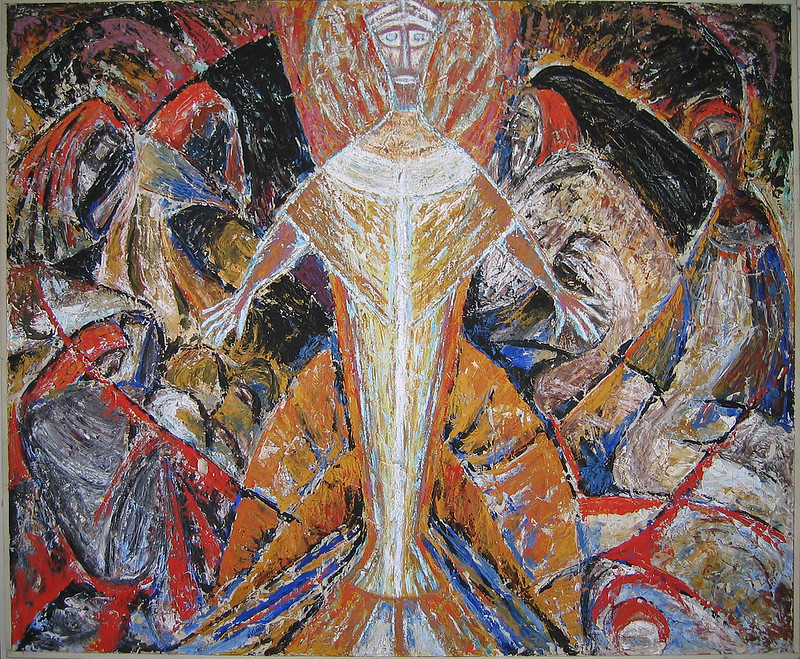
    Anastasis_at_Chora

    Easter Monday
    Brian Zahnd

    The risen Christ is not one who has come back from the dead. The risen Christ is the One who has gone through death and opened the door to the new world beyond death.

    The risen Christ is not one who has wrestled free from the clutches of death to return to the land over which death still holds sway. The risen Christ is the One who has passed all the way through the black hole of Hades into the world of light and life where death cannot go.

    Lazarus is a man who came back from the dead…only to die again. Christ is not a mere survivor of Sheol. Christ is the Conqueror of Sheol who has trampled down death by death.

    Christ was raised on the third day. Lazarus on the fourth. But that doesn’t mean Lazarus is one up on Christ. Oh, no! Lazarus merely came back from the grave…but still a subject to the tyranny of death. Christ went all the way through the grave…and emerged as the Vanquisher of death.
    Read more
  • Jesus Died for Us…Not for God

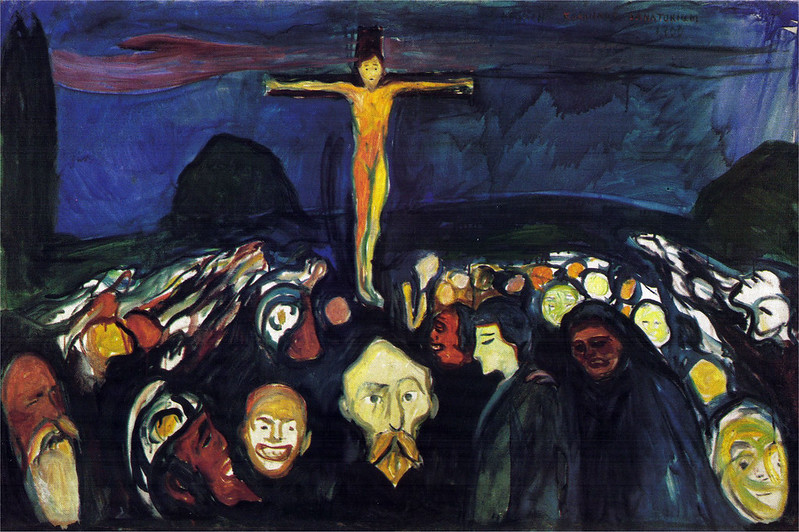
    Edvard_Munch_Golgotha


    Jesus Died for Us…Not for God
    Brian Zahnd

    “You killed the Author of life, whom God raised from the dead.” –The Apostle Peter, Acts 3:15

    Golgotha is where the great crimes of humanity — pride, rivalry, blame, violence, domination, war, and empire — are dragged into the searing light of divine judgment. At Golgotha we see the system of human organization that we blithely call “civilization” for what it is: an axis of power enforced by violence so corrupt that it is capable of murdering God in the name of what we call truth, justice, and liberty.

    Golgotha is also the place where the love of God achieves its greatest expression. As Jesus is lynched in the name of religious truth and imperial justice he expresses the heart of God as he pleads for the pardon of his executioners. At the cross we discover that the God revealed in Christ would rather die in the name of love than kill in the name of freedom. Our savior is Jesus Christ, not William Wallace.

    The cross is both hideous and glorious, simultaneously ugly and beautiful. It’s as hideous as human sin and as glorious as divine love. It is a collision of sin and grace. But it is not a contest of equals. In the end love and beauty win. We call it Easter.
    Read more

  • Peace Donkey On Palm Sunday

    palm-sunday-an_african_jesus_christ_s_triumphal_entry_into_jerusalem_riding_on_a_donkey_to_the_enthusiasm_of_the_crowds

    Peace Donkey On Palm Sunday
    Blind Man At The Gate

    The king approaches on Palm Sunday
    Forsaking the glorious war horse
    To ride a ridiculous peace donkey

    Gentle as the wings of a dove
    Inaugurating the reign of love

    Conquerors come with hubris, blood, and violence
    Riding stallions of famine, war, and pestilence
    (They tell me Genghis Khan murdered all of ten million)

    The Prince of Peace comes without breaking a bruised reed
    Swords are now for plowing, spears are now for pruning
    (I’ll tell you for a fact, Jesus of Nazareth killed nary a one)

    If Hosanna praises rocket’s red glare: Weep over Jerusalem!
    If Hosanna acclaims kingdom come: Let the rocks cry out!

    BZ
    Read more

  • What If Jesus Addressed Congress?

    crucifixion-1

    What If Jesus Addressed Congress?
    Brian Zahnd

    The cross is shock therapy for a world addicted to solving its problems through violence. The cross shocks us into the devastating realization that our system of violence murdered God! The things hidden from the foundation of the world have now been revealed. The cross shames our ancient foundation of violence. The cross strips naked the principalities and powers. The cross tears down the façade of glory that we use to hide the bodies of slain victims.

    In the light of the cross, we are to realize that if what we have built on Cain’s foundation is capable of murdering the Son of God, then whole edifice needs to come down. In the light of the cross, our war anthems lose their luster. But this throws us into a crisis. What other alternatives are there? How else are we to arrange the world? The alternative is what Jesus is offering us when he told us that the kingdom of God is at hand. God’s way of arranging the world around love and forgiveness is within reach. If we only dare to reach out for it, we can have it. But we are so afraid. We’re not sure we can risk it. It’s so hard for us to let go of the sword and take the hand of the Crucified One. It’s so hard for us to really believe in Jesus.

    The crowd never believes in Jesus. Only the little flock that accepts its vulnerability can believe in Jesus. If you tell those rushing to war that their hatred of enemies and their plan for the organized killing of enemies is evil, the crowd will hate you. War is sacred. It lies beyond critique. To critique it is blasphemy. The crowd hates blasphemy. The crowd wants to kill blasphemers. The crowd knows that the criticism of their violence is blasphemy because they know their cause is just. They believe it. And from their perspective their cause is just. They can prove it. Both sides can prove it. Always.

    Achilles knew his cause was just and that it was perfectly legitimate to drag Hector’s body from his chariot in front of the gates of Troy in a show of grotesque triumphalism. It’s the same grotesque impulse that causes modern soldiers to pose for gruesome photos with the bodies of dead enemies. It’s literally the way of the world. But it’s not the way of the new world founded by Jesus. Jesus is not the warrior king the world is accustomed to. Jesus is not the Jewish Achilles. Jesus refused to be the violent Messiah Israel longed for. Jesus did not kill Pilate and drag the governor’s body behind his chariot. Jesus did not pose triumphantly over the dead bodies of slain Roman soldiers. Instead it was Jesus who hung naked on a tree after being put to death through a state-sponsored execution. Jesus founded his kingdom in solidarity with brutalized victims. This is the gospel, but it’s hard for us to believe in a Jesus who would rather die than kill his enemies. It’s harder yet to believe in a Jesus who calls us to take up our own cross, follow him, and be willing to die rather than kill our enemies.
    Read more

  • How Does the Church Differ From America?

    american_jesus

    How Does the Church Differ From America
    Brian Zahnd

    What is the church?

    Is the church a religious building with stained-glass and a steeple?
    Is the church a religious gathering that meets on Sunday mornings?
    Is the church a 501(c) 3 not-for-profit religious organization?

    I don’t want to give a quick and jaded “of course not.” There are reasons why stained-glass and steeples, Sunday gatherings and not-for-profit status have become associated with the church.

    But…

    In the end this is not what the church is.

    Maybe the church is something like this: The other way of being human (together). The way given to us by and built around Jesus Christ.

    The church is a distinct way of being human.
    Read more

  • Jesus Is What God Has To Say

    >TRANSFIGURATION

    Jesus Is What God Has To Say
    Brian Zahnd

    One of the most mysterious aspects of the Transfiguration is the appearance of Moses and Elijah — these two giant figures from the Old Testament — conversing with a glorified Christ. Of course Moses the Lawgiver and Elijah the Prophet are representative figures signifying the Law and the Prophets. On Mount Tabor, Moses and Elijah are summoned from the Old Testament past to give their final witness.

    The goal of the Law and the Prophets was to produce a just and worshipping society. Jesus and his kingdom is where that project finds its fulfillment. The new society formed around Jesus was what the Law and the Prophets were aiming for all along. The Transfiguration is where Moses and Elijah find their great successor. The Transfiguration is where the Old Testament hands the project of redemption over to Jesus. The Transfiguration is where the old witness (testament) yields to the new witness (testament.)

    But initially Peter misinterpreted what the presence of Moses and Elijah meant.

    Peter’s first impulse was to build three memorial tabernacles on Tabor, treating Moses, Elijah, and Jesus as approximate equals.

    But Peter’s idea received a strong rebuke when the voice from heaven said, “This is my beloved Son, listen to him!”

    Jesus is the true and living Word of God. Jesus is what the Law and Prophets point toward and bow to. Jesus is what the Old Testament was trying to say, but could never fully articulate. Jesus is the perfect Word of God in the form of a human life. God couldn’t say all he wanted to say in the form of a book, so he said it in the form of Jesus. Jesus is what God has to say!
    Read more

  • Achilles or Immanuel?

    IMG_4926

    Achilles or Immanuel?
    Brian Zahnd

    I just returned from seeing An Iliad at The Kansas City Repertory Theatre — a one act telling of Homer’s Iliad — and I can’t rest until I share a few thoughts…

    The eighth century BC gave the world two great poets — the Greek Homer and the Hebrew Isaiah. These two poets offer competing visions of the heroic. Homer’s epic poem The Iliad opens with these lines.

    Rage — Goddess, sing the rage of Peleus’ son Achilles
    murderous, doomed, that cost the Achaeans countless losses,
    hurling down to the House of Death so many sturdy souls,
    great fighters’ souls, but made their bodies carrion,
    feasts for the dogs and birds.
    (Iliad 1–5)

    But the poet Isaiah sings a different song.

    The boots of the warrior
    And the uniforms bloodstained by war
    Will all be burned
    For unto us a Child is born
    Unto a Son is given
    And he shall be called…
    The Prince of peace
    His government and its peace
    Will never end
    (Isaiah 9:6–7)

    Read more

  • The Magi and I

    journey-of-the-magi

    T.S. Eliot’s poem Journey of the Magi with my quasi-interpretation of it. Which is more than an interpretation — it’s also a kind of autobiographical confession; for I too have had a hard time of it. And like Eliot’s Magi I would do it all over again.
    Read more

  • Christmas Shock and Awe

    seeingshepherds

    Christmas Shock and Awe
    Brian Zahnd

    Suddenly the angel was joined by a vast host of others,
    The armies of heaven,
    Praising God and saying,
    Glory to God in the highest,
    And peace on earth.

    –Luke 2:14

    This is Christmas shock and awe. D-Day circa 5 BC. The night skies over Bethlehem are suddenly filled with an invading army — an army from another world, an army representing another government, an army from heaven. This army has come in the cause of regime change. The world is about to be given a new day, a new kingdom, a new lease on life. Caesar, Pharaoh, Herod and all their kind are being supplanted by a newborn king — the King of the Jews. He is the long-awaited Prince of Peace. This is why the armies of heaven are invading the night skies over Bethlehem.

    Nearly 250 times the Old Testament describes the God of Israel as the LORD of Hosts, Yahweh Sabbaoth, the Lord of Armies. Now at the birth of God’s chosen king the armies of heaven invade earth with shock and awe. This is why the shepherds were “sore afraid.” But they need not have been. This is not a killing army, but a singing army. This army comes, not to kill, but to carol.

    The text in Luke says the angels were saying, but Christian imagination has interpreted their saying as singing. I like that. The army of heaven is a choir — combat by chorus. The army of heaven doesn’t launch missiles, it launches into song. The heavenly army sings of the glory of God and of peace on earth.
    Read more