All posts in Uncategorized

  • An Idol Called ‘The Economy’

    3_flowers_dark_painting


    An Idol Called ‘The Economy’
    By Blindman at the Gate

    America worships an idol called
    The Economy
    All bow to her holiness
    The Economy
    Justice for the indigent and immigrant
    Care for the ill and infirm
    Must first be approved by
    The Economy
    Americans “vote their pocketbook”
    A sacrament offered to
    The Economy
    Presidents and politicians are mostly priests to
    The Economy
    Political speech is a liturgy venerating the primacy of
    The Economy
    (Question it at your peril)
    It’s a sacrosanct article of faith
    Nothing is more important than
    The Economy
    We can talk about guns and wars and doctors and borders
    But we genuflect before
    The Economy
    A heretic speaks—
    “There are things more important than The Economy”
    Blasphemy!
    Let us speak truth—
    “It’s The Economy, stupid!”
    God save
    The Economy
    God bless
    The Economy
    God is
    The Economy
    The Economy
    The Economy
    $ $ $

  • To Mend the World

    Christ

    To Mend the World
    by Brian Zahnd

    November 9, 1938 resides in the catalog of human crimes as Kristallnacht—The Night of Broken Glass. On that dreadful night when Nazi storm troopers smashed, ransacked, burned, and destroyed Jewish homes, synagogues, and businesses throughout Germany, Emil Fackenheim was among the thirty thousand Jewish men arrested and taken to concentration camps. Through an improbable twist of fate the twenty-two year old Fackenheim managed to escape the Sachenhausen concentration camp and was eventually able to get out of Nazi Germany. Following the war he made his way to Canada where he became a prominent Jewish philosopher and Reform rabbi. In 1982 Fackenheim wrote To Mend the World, an influential book on post Holocaust Jewish thought. The title comes from the Jewish theological concept of tikkun olam—“repairing the world.” Tikkun olam is the idea that though the world is broken, it is not beyond repair—that it’s God’s intention to work through humanity in order to repair his creation. Read more

  • Leap!

    leap

    LEAP!

    And shall I go on being casual and numb?
    Pretending
    Pretending that I know something about this being I so glibly call God
    Or shall I dare to encounter Him?
    Him
    The One with whom I have to do
    The One who can never be an object
    Forever and always the eternal subject
    Is it grammar or a much deeper truth?
    The object is acted upon but the subject acts
    God is not in my story—I am in His
    How is it I can be unaware of this?
    Did I think I invented this story called being?
    Surely I’m not that crazy
    I belong to His story
    History
    But there is my story
    Mystery Read more

  • Satan and Empire

    1315919755_1315919755_babylon

    Satan and Empire

    When asked to identify the origin of Satan we are commonly directed to Isaiah 14. This is the passage where the King of Babylon is called Lucifer (Day Star) and described as “fallen from heaven” after coveting the throne of God. But what should be readily apparent is that Isaiah is giving us a prophetic critique of empire by using the king of Babylon as a personification for the whole imperial project. This is quite clear from a simple reading of the text. Throughout Scripture (and especially in the book of Revelation) Babylon remains a prophetic symbol of empire and the kingdom of Satan.

    Here are a few thoughts from Isaiah 14… Read more

  • Leaving Country and Kin

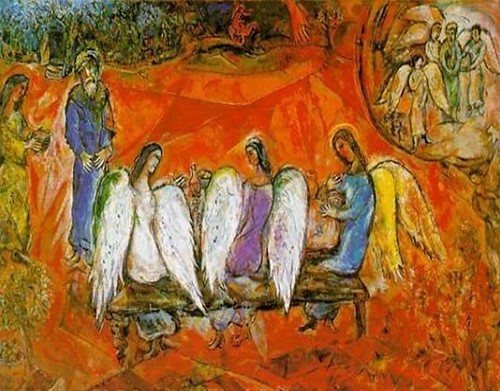
    img_1128040_33684174_23

    Leaving Country and Kin

    Now the Lord said to Abram, “Go from your country and your kindred…”
    And Abram went.
    (Genesis 12:1, 4)

    In the story the Bible tells it’s Abraham who sends the narrative in a new direction—from a steady migration away from God, to a journey into the Unknown and toward God. Prior to Abraham what do we find in the story? Adam and Eve expelled from Paradise, Cain killing Abel and founding human civilization with bloody hands, a violent world under a flood of judgment, and finally Babylon rising in rebellion to God. It’s a world moving away from God.

    Enter Abraham.
    Faith man.
    Walking man.
    Friend of God.
    Patriarch of a new humanity. Read more

  • Advent Scripture Reading Guide

    MareDeu Advent and the start of the Christian calendar begins on Sunday, November 27. I love the Christian calendar! It enables us to re-tell, re-live, and re-enter the Jesus Story — from the crowded stable to the empty tomb. We are a peculiar people and we have a peculiar calendar. We live in a secular world but we belong to a sacred story. And so we have two calendars — one secular, one sacred. What we want is to be formed by the Gospel Story. And the Gospel is a story! The Gospel is not a plan or theory or philosophy or ideology — it is a story! The story of Jesus of Nazareth. This is the story told in the Christian calendar: Advent (waiting for Christ), Christmas (the twelve day celebration of Jesus’ birth), Epiphany (the revelation of Christ to the Gentile magi), Lent (the journey to the cross), Holy Week, (Palm Sunday, Good Friday, Holy Saturday), Easter (Resurrection!), Pentecost (the birth of the church). Then it’s Ordinary Time until we return to Advent.

    To help you observe Advent in a richer, more meaningful way, I have put together an Advent Scripture Reading Guide. It comes (mostly) from the second half of Isaiah and the synoptic gospels up to the Transfiguration. It consists of one chapter from Isaiah and one chapter from the Gospels each day (with two chapters from the Gospels on Sundays). So re-enter and re-live the mystery of the Gospel story through this Advent Scripture Reading Guide. (Pass it on to others!)

    Happy Holy Days,

    BZ Read more

  • A (Troubling) Parable

    6big

    A Parable
    by Lee C. Camp
    From his book Who Is My Enemy?

    A king went out to conquer, amassing great wealth and power. There came to him a people who asserted that some other was king, whom they called “Lord of Lords.” The king replied: you may freely worship this one you call “lord,” you may freely build your buildings and write your books and seek your converts to this one you call “lord.” But I shall rule the marketplace, and the army, and the public square. He shall be your personal “lord,” while I am your public king. I shall make the laws, and you shall obey them. I shall tell you what enemies to kill, and you shall kill them. I shall give you a marketplace, and you shall seek to maximize your profits and keep all your profits, even at the expense of the poor, or the widow, or the stranger, and thence you shall pay taxes with which we shall wage war against all who threaten your freedom to worship your personal “lord.” Read more

  • Karl Rahner’s Prayer

    incarnationA
    ____________________________________________

    My friend Sister Ginny, a Benedictine nun, sent me this prayer composed by the great Jesuit theologian Karl Rahner. I think it is worth sharing, worth meditating upon, and most of all, worth praying.

    O God, whenever I think of Your Infinity, I am racked with anxiety, wondering how You are disposed to me. You must adapt Your word to my smallness, so that it can enter into this tiny dwelling of my finiteness—the only dwelling in which I can live—without destroying it. If you should speak such an “abbreviated ” word, which would not say everything but only something simple which I could grasp, then I could breathe freely again. You must make your own some human word, for that is the only kind I can comprehend. Don’t tell me everything that You are; don’t tell me of Your infinity—just say that You love me, just tell me of Your Goodness.

    Beautiful.

    It’s significant that this prayer was composed by a brilliant German theologian.

    You must adapt Your word to my smallness…make your own some human word…

    Of course, this prayer is answered in the Incarnation—the Word made flesh and adapted to our smallness telling us of the love and goodness of God.

    Amen.

    BZ

    (The painting is Incarnation by Edward Longo)

  • Come With Me

    visitation0ix

    The knowledge of God’s mystery is Christ.
    –The Apostle Paul

    Our hearts are restless until they find their rest in Thee.
    –Saint Augustine

    I dreamed I saw St. Augustine, alive as you or me.
    –Bob Dylan

    A bit of autobiography, because we are our stories
    And we are known in the telling of our stories…

    It was a Sunday afternoon in June and I was sitting on my porch reading a very old book. The book was The Confessions of Saint Augustine and I was reading it primarily because I was somewhat embarrassed that I never had. I knew Saint Augustine was a towering figure whose influence on the church and Christian thought cannot be overemphasized, so I eventually decided I ought to read his spiritual autobiography. Some have called Confessions the first real autobiography in history and if not the first it is certainly one of the most influential. Written 1,600 years ago, the entire book is a prayer—that is, it is addressed to God in the form of a three hundred page prayer of thanksgiving as Augustine reviews his life from his days as a profligate sinner to his life-altering encounter with Jesus Christ. As I sat with old Saint Augustine on my porch that Sunday afternoon, I had no inkling that the story of a fourth century church father would become a pivotal point in my own spiritual pilgrimage. But because it’s a great story and also because it pertains to what I want to tell you, let me share with you how Augustine became a Christian. Read more