• Have We Become Death?

    ku-xlarge

    Have We Become Death?
    Brian Zahnd

    First watch this video…

    Now let’s step back and think for a moment about where we stand as a people and a planet. It’s easy to imagine that the world doesn’t really change — that it simply marches around the maypole of violence trampling the victims into the mud same as it ever has. But as true as that may be, something has changed. We are post-something. If nothing else we are post 1945 when the Enlightenment dream of attainable utopia went up in smoke — literal smoke! — from the chimneys of Auschwitz and a mushroom cloud over Hiroshima.

    After 1945 we lost our blind faith in the inevitability of human progress. A threshold was crossed and something important changed when humanity gained possession of what previously only God possessed: the capacity for complete annihilation. In yielding to the temptation to harness the fundamental physics of the universe for the purpose of building city-destroying bombs have we again heard the serpent whisper, “You will be like God”?
    Read more

  • Halloween: A Search For The Sacred

    the-bored-gargoyle-of-notre-dame-2

    Halloween: A Search For The Sacred
    Brian Zahnd

    It’s Halloween. The season of ghosts and goblins, haunted houses and horror movies. The modern observance of Halloween seems, for the most part, to be an innocent celebration of the strange joy of being scared. There’s no doubt that a significant number of us do enjoy being scared as a form of entertainment. How else do you explain that Stephen King has sold half a billion books?! But why? Why do we like to be scared? I think it has to do with a search for what is most missing in the modern world: the sacred. We like being scared because we are so very secular.

    When modernity came of age it banished the sense of the sacred. Empiricism, materialism, positivism had won the day. Science was now the high priest that would answer all questions and religion was merely the superstition of the hopelessly naïve. We found ourselves in a world without God or gods, a world beyond good and evil (as Nietzsche said), a world without angels and demons. Religion was but hucksterism and nothing was truly sacred anymore. Bob Dylan captured it well when he said,
    Read more

  • “You’re Not A Pacifist Are You?”

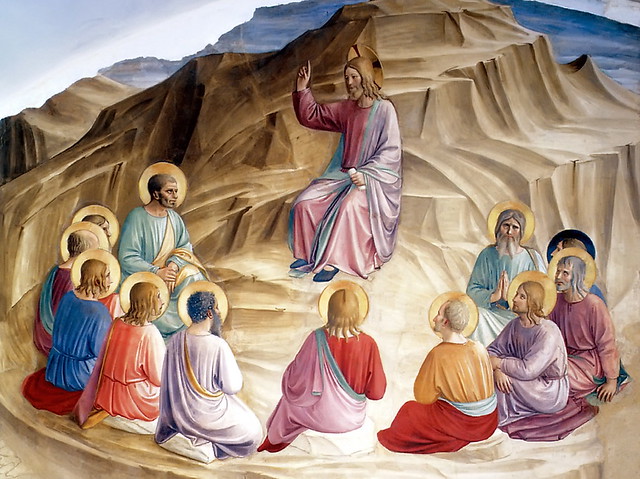
    sermon-on-the-mount-by-fra-angelico-c1440

    “You’re not a pacifist are you?”

    I get that question a lot. People who have read my books or heard my sermons will often “confront” me with that question. There seems to be a hint of scandal implied in the question, like asking, “you’re not a pornographer are you?” This strikes me as a bit strange. I suppose the hint of scandal comes from the assumption that pacifism is a sort of cousin to cowardice. This also strikes me as strange. To endorse the dominant view that the employment of violence is compatible with Christianity requires no courage at all — that’s just following the crowd. But to differ from the dominant view on the sanctity of state-sponsored violence may require an uncommon reservoir of moral conviction. Pacifism is not a popular position in America, and especially not among patriotic evangelicals who have ardently sought to amalgamate the American state and the Christian faith into one hybrid entity. Still I know what you’re wondering: what’s my answer to the loaded question about pacifism?

    First of all, I don’t like labels. Kierkegaard was right when he said, “when you label me, you negate me.” Just call someone a pacifist and you can dismiss them with a wave of your hand. Labels are often a way to avoid thinking. “Oh, he’s one of those.” Case closed. Mind closed. That being said, I have no problem with Christians who adopt the label of pacifist — if nothing else they provide an alternative witness to that of the Christian militarist whose numbers are legion.

    But I actually don’t claim the label of pacifist, and for this reason: pacifism is a political position on violence; it’s a position one could adopt apart from Jesus Christ — as for example the great writer and humanist Kurt Vonnegut did. But I am not a political pacifist. What I am is a Christian. And as a Christian we can talk about how Christ informs humanity on the subject of violence.
    Read more

  • Mass Suicide

    communion-of-saints-elise-ritter

    Mass Suicide

    “The Eucharist becomes the meal of unity binding Christians through time and space to be one body, one Christ, for the world. That we have been made one makes it impossible, therefore, for Christians to contemplate killing other Christians with whom we share this meal. Such killing is not murder, it is suicide.”

    —Stanley Hauerwas, Commentary on Matthew, pg. 219

    This may explain the death of Christianity in Western Europe following the two world wars.
    It was mass suicide.
    Or Mass suicide.
    Selah.
    Read more

  • Columbus Day

    columbus-in-prison

    Columbus Day
    Brian Zahnd

    It’s Columbus Day in America. Well, depending on where you live. South Dakota, Oregon, Alaska, and Hawaii don’t recognize Columbus Day. Where Native Americans still have a fairly visible presence Columbus Day can be a bit awkward. In South Dakota today is a state holiday — “Native American Day.”

    Growing up in Missouri I knew Columbus Day as the celebration of the “discovery” of America. Which lets slip the obvious fact that the story is being told from a European vantage point. Last May Peri and I arrived for the first time in Portugal, but we hardly “discovered” Portugal. Yet from our perspective we were making a new discovery. (We did refrain from claiming to now own Portugal.)

    Contrary to what you may have thought, Columbus did not arrive on the shores of an empty wilderness, but on the shores of a world more populous than Europe. Tenochtitlan (Mexico City) was larger than any European city. But armed with guns, steel, and germs, and driven by the conquistador’s lust for gold and slaves, the population of the Americas was decimated. Columbus discovered America like that asteroid discovered the dinosaurs.
    Read more

  • Who Are the Children of God?

    baby

    Who Are the Children of God?
    Brian Zahnd

    He prophesied that Jesus would die for the nation,
    and not for the nation only,
    but also to gather into one
    the scattered children of God.
    —John 11:51-52

    Who are the children of God?

    One way of answering the question is to say—
    All who recognize the rest as their fellow siblings are children of God.

    Those who refuse to recognize the other as their sister and brother—
    These are the children of the devil.

    (The devil is the original murderer and liar — leading Cain to murder his brother and to lie about it. cf. John 8:44)

    If you can see the other as your sister and brother—
    You are on your way to becoming a child of God.

    Another way of saying it is—
    God does not participate in our sibling rivalries.

    (You may have to live awhile to come to terms with this.)

    We want to say—
    Dad loves me better than you.

    But it isn’t true.

    The sooner we learn that God loves all his children—
    The sooner we learn to live as the children of God.

    Selah
    Read more

  • The Journey Goes On

    DSCF1181

    The Journey Goes On
    Brian Zahnd

    The journey goes on
    And I find myself in a place
    I could never have imagined
    (And I mean a good place!)

    Not in the Love Song 70’s
    Not in the Ravenhill 80’s
    Not in the Faith Man 90’s
    Not even the tumultuous 2000’s

    I won’t make an idol of any moment in time
    The vastness of God can’t be explored in the blink of an eye
    We don’t attain authenticity overnight
    So I’m a mystery
    Even to myself

    The 70’s Jesus Freak
    The 80’s Revivalist
    The 90’s Church Growth Guy
    The 2000’s Trouble Maker
    Could never understand who I am today
    Which makes me somewhat happy

    Because it’s not the reinvention of self for fashion sake
    Like the widening and narrowing of neckties
    No, it’s about being true to Christ by being true to yourself
    The sacred mystery is about the adventure of becoming
    So the journey goes on
    And on

    But through it all I remain loyal to the Way
    Because when Jesus called BZ to follow him
    (That long-haired fifteen year old kid)
    And he said, yes
    He meant it

    I can’t be labeled and classified
    The way entomologists pin insects
    I believe in metamorphosis!
    Whatever bug you pin me down as
    I will not be
    (Does that bug you?)

    I’m a dweller by a dark stream
    And the chrysalis is cracking
    Like in the vision John saw
    (Thank you, my prophetic Canadian brother)
    In the end I’ll have wings
    And I will fly

    BZ
    Read more

  • Reading the Bible Right

    Reading The Bible Right
    by Brian Zahnd

    (An old poem resurfaces. It’s best read aloud.)

    It’s a STORY
    We’re telling news here
    Keeping alive an ancient epic
    The grand narrative of paradise lost and paradise regained
    The greatest “Once upon a time” tale ever told
    The beautiful story which moves relentlessly toward—
    “They lived happily ever after”

    Never, never, NEVER forget that before its anything else it’s a story Read more

  • The Killing Idea

    killing

    The Killing Idea
    Brian Zahnd

    By the killing idea I mean the idea of the modern killing spree. This idea, in the sense I mean it, seems to be a relatively new idea. I’m talking about the phenomenon where one or two individuals enter a school, a theater, a mall, a church, a military installation, or some other public space and randomly kill as many people as possible with the aid of modern firearms. This is a phenomenon that is now a regular occurrence in American life. It has become an idea. Something one can do. A possible course of action. An option. I don’t know if this idea occurred to people in earlier contemporary times, but it seems to have been infrequently acted upon if it did. But now the idea is out there. As an idea it has become a viable option. It is now on the menu of possible ways to respond to frustration over this or that. This idea coupled with the availability of modern firearms allows one or two individuals to wage a very brief and highly violent war upon unsuspecting innocents for the sake of an ideology, or as an expression of rage, or as a way of throwing a final lethal tantrum as one exits this life. It’s an idea. Or you could call it a demon. Anyway, it’s out there.

    But what I find baffling is how tolerant it appears American society is of this idea. Or at least American legislative bodies. Oh, we don’t like it, but we are determined tolerate it. We don’t seem to have an alternative idea to curb this killing idea that doesn’t impinge upon what is thought of as “freedom” or some “right.” So the killing idea is tolerated.
    Read more