• A Monologue On Syria
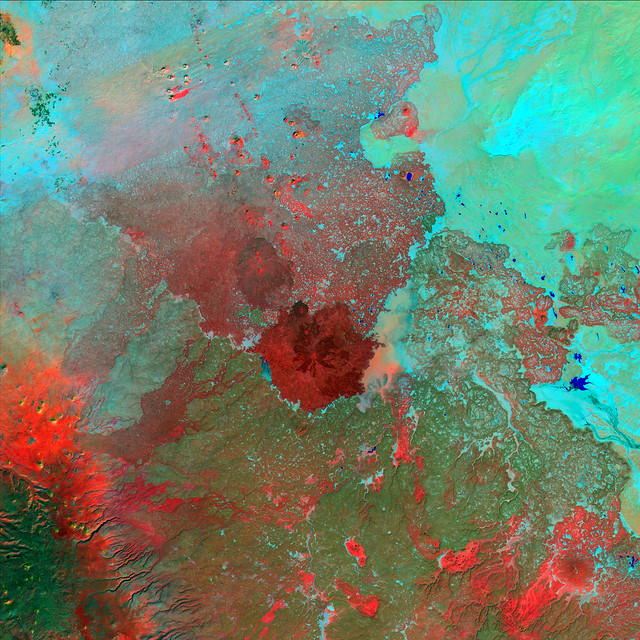
    landsat_syria_artII_lrg

    A Monologue On Syria
    Brian Zahnd

    Love your enemies…
    And you will be children of the Most High.
    For God is kind to the ungrateful and the evil.
    You must be merciful, just as your Father is merciful.
    –Jesus

    So Jesus’ fame spread throughout all Syria.
    –Matthew

    I’m crossing the street to get away from a mangy dog
    Talking to myself in a monologue
    –Bob Dylan

    INTERNAL MONOLOGUE

    “What about Syria?”

    The world again convulses in brutality. Another macabre dance around the maypole of violence. The killing escalates. Shot, stabbed, beaten, burned, bombed, gassed, the bodies pile up, the death toll mounts. It’s a world gone wrong.

    “A red line has been crossed.”

    The red line was crossed a long time ago — it was crossed when Cain killed Abel. We’ve been living on the wrong side of the red line ever since the first city was built with bloody hands. Killing innocents for the sake of power is nothing new. It’s what we humans do.

    “But surely you condemn the use of chemical weapons?”
    Read more

  • Contemplation

    moment-of-contemplation-judy-mackey-2944

    Contemplation
    Brian Zahnd

    I practice contemplation. It’s important. We either gain new perspectives or we forever look at the world the same way — which is to say, we never change. In order to see the world the way God sees it we need contemplative breakthroughs.

    In the tenth chapter of Acts we find the story of the Apostle Peter’s contemplative breakthrough — a breakthrough that altered the entire course of Christianity. The fisherman apostle was staying in the seaside town of Joppa. At noon he went up on the roof of Simon the Tanner’s house to observe one of the designated hours of prayer. While in prayer Peter went into a trance (ekstasis) and saw something — a great sheet filled with non-kosher animals being let down from the sky. A voice instructed him to “kill and eat.” Peter refused saying, “By no means, Lord; for I have never eaten anything that is profane or unclean.” The voice from heaven replied, “What God has made clean, you must not call profane.” This happened three times. As a result of this mystical experience Peter was willing to accept an invitation to enter the home of a Gentile — something he had never done before. When Peter arrived at the home of Cornelius, a military officer in the occupying Roman army, Peter said—

    You yourselves know that it is unlawful for a Jew to associate with or visit a Gentile; but God has shown me that I should not call anyone profane or unclean…I truly understand that God shows no partiality, but in every nation anyone who fears him and does what is right is acceptable to him. (Acts 10:28, 34–35)

    The implications of this breakthrough are incalculable. Peter’s new perspective opened the door for the gospel of Messiah to be preached to Gentiles. But how did Peter arrive at this new perspective? Peter had a limited ethnocentric worldview. For Peter, Yahweh was the God of Jews only. Jesus was the Messiah for Jews only. The community of Messiah was for Jews only. If Gentiles wanted to be accepted by Yahweh and be saved by Messiah they had to become Jews first — be circumcised, keep kosher, observe the Torah. Peter was locked into a Jewish-only perspective of God, Jesus, and the gospel. This was not just Peter’s theological perspective, it was his personal identity — how he understood his place in the world. What Peter knew for sure was that to be accepted by God one had to be a Jew!

    But Peter’s ethnocentric perspective began to change when he had a contemplative breakthrough while praying on Simon the Tanner’s rooftop. In a trance he was shown non-kosher food and told by God to break the law and eat it! Peter was being instructed by God to break the law of Moses! Talk about cognitive dissonance! But Peter got the message — he was to stop classifying other people as non-kosher and unacceptable to God. Now Peter would break the Jewish law he had always observed and enter the home of a Gentile. Without a contemplative breakthrough this would have been impossible.
    Read more

  • John Piper and Allahu Akbar

    A friend brought these remarks of John Piper to my attention and asked me to respond. I’ve already posted a blog on the topic of God and Genocide, but here are a few thoughts.

    I understand that the disciples of John Calvin feel obligated to defend their ism at all costs, but my, what a cost it is when it requires impugning the character of God! God is revealed in Jesus, not genocide. The perfect image of God is Christ, not Calvin’s ism.

    What I see here is the distortion of God to supreme and capricious Will in order to make a certain theological system work. As if the landmark verses of the New Testament read…

    In the beginning was the Will, and the Will was with God, and the Will was God.

    Now abide these three: faith, hope, and will, and the greatest of these is will.

    God is will.

    Once you reduce all that exists or occurs to God’s will, you have moved out of the Judeo-Christian understanding of God into Voluntarism or even Pantheism. Was Nietzsche right? Is everything ultimately about the Will to Power? In the kind of absolute determinism that John Piper espouses there is no authentic being, no genuine freedom, only the sheer will of God. Which begs a question: Is human drama (and everything else) nothing more than a movie playing in God’s head? Is what we know as life nothing more than God’s dream…or nightmare

    Or perhaps it begs a more provocative question…

    When the suicide bomber (to use Piper’s example) shouts Allahu Akbar! (God is great!) and detonates his bomb, does John Piper say, “You’ve got a point there”?

    But what I really want to say is this…
    Read more

  • Grateful (Guest Post from Ashlie Zahnd)

    2013-08-06 07.54.24

    A year ago today, my then 2-year old grandson Jude Andrew Zahnd had surgery to remove a large life-threatening cancerous tumor. To celebrate a year of Jude being healthy, I’ve invited a special guest to my blog–Jude’s mother, my daughter-in-law, Ashlie Zahnd.

    BZ


    Grateful by Ashlie Zahnd

    After much frustration in trying to get my 3 year-old to lay down and take “just a little nap” and many requests for me to rock him “just a little bit,” I gave in. Usually, his requests to rock are just a ploy to get out of bed and then he can’t seem to be quiet or hold still long enough to fall asleep or even grow drowsy. But I decided today I’d try again, just for the slight chance I’d get the opportunity to rock my big baby to sleep. And oh how glad I am that I did.

    I thanked God for the small miracles in Jude’s new little healthy body.
    Rocking Jude today gave me yet another opportunity to thank God for his grace and mercy in healing Jude and allowing us the opportunity to be his parents here on earth and to watch him grow. As I rocked him today, I studied each part of his growing body and thanked God for the small miracles in Jude’s new little healthy body.

    Read more

  • Who Belongs In Hell?

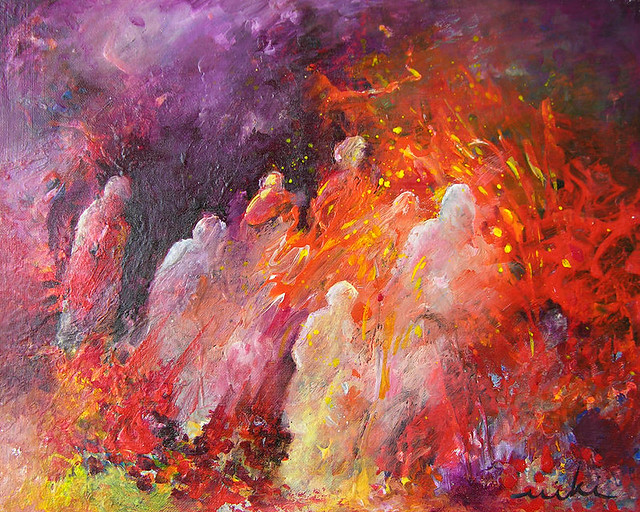
    souls-in-hell-miki-de-goodaboom

    Who Belongs In Hell?
    Brian Zahnd

    Oh, no, I’m not about to get into the hell of debating hell and who’s there! If you know the exact census of hell, good for you…I don’t. But I do want to share a quote from one of my favorite and most trusted theologians and spiritual guides — Hans Urs von Balthasar. That’s all. I hope you will think about it.

    “Hell is to be contemplated strictly as a matter which concerns me alone. As part of the spiritual life it belongs behind the ‘closed door’ of my own room. From the standpoint of living faith, I cannot fundamentally believe in anyone’s damnation but my own; as far as my neighbor is concerned, the light of resurrection can never be so obscured that I would be allowed or obliged to stop hoping for him.”

    —Hans Urs von Balthasar, Prayer, p. 302

    BZ
    Read more

  • The Poetic and the Prophetic

    The poetic and the prophetic are related.
    The poet and the prophet are often one and the same.

    The Hebrew prophets were artistic poets.
    Their songs giving melody to a God-breathed perspective.
    Their poems were holy in their imagination—
    An alternative to the tyranny of the status quo.

    These God-obsessed poets were the prophets of the holy… “What if?”
    What if justice rolled down like a mighty river?
    What if swords were turned into ploughshares?
    What if the government were on God’s shoulders?

    And the Hebrew poets weren’t the only prophets.
    The Apostle Paul calls the Greek poet Epimenides a prophet.
    In a pagan hymn it’s Epimenides who sang of God—
    “In him we live, and move, and have our being.”
    The soul of the poet is the seed-bed of prophecy.

    So where do we find the poet-prophets today?
    More likely than not their making music—
    Singers, songwriters, musicians.
    Let him who has ears to hear, hear!

    Finding God on your iPod begins Sunday, July 28th and runs through every service in August.

    BZ
    Read more

  • A Premodern Sacramental Eclectic

    DSC00210

    A Premodern Sacramental Eclectic
    Brian Zahnd

    Ten years ago I was a poverty-stricken Christian…and I didn’t even know it. My poverty was theological and it was the sad consequence of my arrogant sectarianism. By restricting my Christianity to the narrow confines of modern charismatic evangelicalism I suffered from a self-inflicted theological poverty. I needed the riches of the whole church. I needed to be able to draw upon the broad spectrum of Christian thinkers and theologians, mystics and writers. I needed to become eclectic in my approach to Christianity. A Christianity that is sufficiently broad and eclectic liberates us from an arrogant and impoverished sectarianism.

    In my youthful arrogance (the word I really want to use is stupidity) I effectively defined and limited Christianity to my kind of Christianity — a charismatic flavored evangelicalism. As far as I was concerned, most Catholics, Orthodox, Anglicans, and mainline Protestants needed to “get saved” — which is to say, they needed to become my “style” of Christian. There were times in my twenties and thirties when I was particularly antagonistic toward Catholics and mainline Protestants. I thought Catholics belonged to the “whore of Babylon” and mainliners were all “liberal goats.” How egotistical! How stupid! I’m ashamed of all that now. I have repented. Which means I’ve called my former attitude sinful and changed my mind — I simply don’t think that way anymore.
    Read more

  • Hero or Saint?

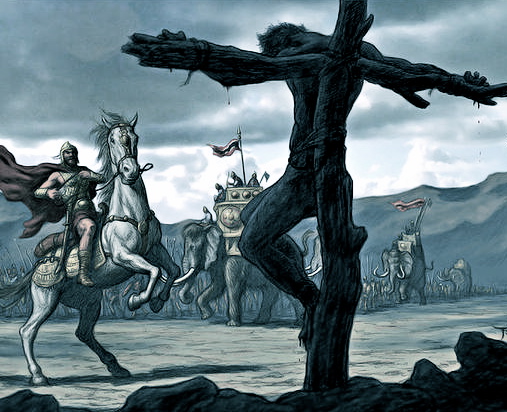
    milesteves-Ancient-Crucifixion

    Hero or Saint?
    Brian Zahnd

    In the Western world we are deeply conditioned to choose the heroic over the saintly. We love our heroes best of all. Heroes are goal-oriented people of great capabilities who know how to make things happen. We admire their ability to get things done and shape the world according to their will. Saints on the other hand — especially to the American mind — seem quaint and marginal, occupying religious spheres on the periphery of the action. We want to be heroes, we don’t really want to be saints. The difference between the heroic vision and the saintly vision is a fundamentally different way of viewing the purpose of life.
    Read more

  • Ten Flags

    American-Flag-twincherrie-30966009-2560-1691

    Ten Flags
    by Blind Man at the Gate
    (This poem is mostly true)

    Today I saw ten flags in ten minutes
    Of the stars and stripes variety
    Three were flown from churches
    With marquees that said things like
    “Celebrate Freedom”
    Five were flown in front of banks
    The biggest one waved proudly above a
    Perkins Restaurant
    (Omelettes starting at $6.99)
    The highest one flew atop a
    Wal-Mart
    Of the Supercenter variety
    (Open 24 hrs)
    Ain’t this America
    With liberty and justice and omelettes
    And low mortgage refinancing for all
    Freedom is what it’s called
    Freedom is what it’s about
    Freedom is what we’re fighting for
    Just remember buckaroo
    Freedom isn’t free
    It starts at $6.99
    With 7.39% APR financing
    (Rates adjust annually thereafter)
    O say!
    Does that Star Spangled Banner yet wave
    O’er
    Churches and Banks and Perkins and Wal-Mart?
    Freedom© made in America®
    Freedom of religion and commerce and omelette
    Freedom to buy cheap apparel made in Guatemala
    I’m proud to be an American
    Where at least I know I’m free
    Ev’ry heart beats true
    ‘Neath the Red, White and Blue
    Support our troops
    Buy American. Save Jobs.
    Financing options available
    Today I saw ten flags in ten minutes
    Read more